
Healthcare institutions are shifting from passive diagnostic software to autonomous AI agents designed to directly manage clinical workflows in specialties like cardiology and primary care. This shift marks the definitive transition from passive ‘copilot’ scribes to active execution engines capable of autonomous clinical decision-making. The driver behind this transformation is a combination of severe operational margin compression and strategic federal backing designed to test algorithmic clinical management at scale.
Where the signal came from
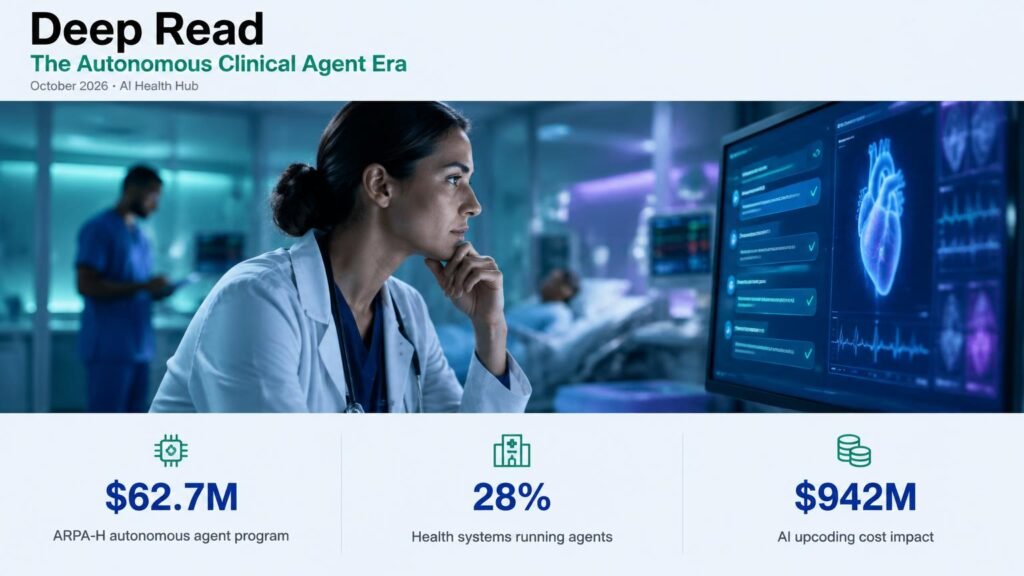
The transition toward direct clinical autonomy reached a critical regulatory threshold with Anthropic joining the $62.7 million ARPA-H ADVOCATE program, a initiative explicitly tasked with developing FDA-authorized autonomous AI agents to actively manage chronic heart failure without direct human oversight. Concurrently, public policy aligned with this direction through an HHS Request for Information focused on establishing governance structures for autonomous AI agents operating directly inside clinical care workflows. Regulatory clearance also confirmed this trajectory when Powerful Medical received FDA De Novo authorization for the Queen of Hearts AI ECG model, enabling autonomous analysis of cardiac scans to directly trigger emergency triage protocol.
In primary care, technology consolidation reflects this same strategic priority. Elation Health’s acquisition of Aster signals an immediate pivot in primary care infrastructure toward EHR-embedded agentic AI tools that independently execute follow-up, referral routing, and billing rather than waiting for manual clinician prompts. Globally, institutional backing has expanded: Heidelberg University Hospital initiated the €15.8 million EU-funded ResPECT project to deploy autonomous generative agents across oncology and mental health care pathways. Industry deployment data corroborates this momentum, with a broad market report revealing that 28% of surveyed U.S. health systems now have agentic AI active in production environments.
What’s actually shifting
For five years, digital health providers sold ambient scribes and diagnostic copilots under the premise that reducing clicks would solve physician burnout. That core assumption has failed to deliver financial returns. As detailed in recent health system cost analyses, operating margins hover near 0.5 percent, and passive software overlays simply shift administrative work around without reducing actual labor overhead. Passive software asks clinicians to review, edit, and approve every generated output. Autonomous agentic systems invert this paradigm by taking action independently within defined parameters, requiring human intervention only when exceptions occur.
Structurally, this means moving away from point-solution diagnostic algorithms that process isolated data inputs—such as a single image or discrete waveform—toward agentic architectures capable of closed-loop execution. Clinical trial data validating an auditable multimodal agentic system in acute stroke care demonstrated that autonomous algorithms synthesizing CT, ECG, and lab data can outperform human specialists in sequential emergency decision-making. The software is no longer acting as a passive reference tool; it is driving the clinical care pathway directly.
However, this rapid transition exposes immediate structural friction. The primary challenge is no longer baseline model intelligence, but operational integration and strict verification. A recent benchmark evaluation showed that autonomous AI agents suffer from high error rates when performing unsupervised, complex multi-step data processing. Without rigid human-in-the-loop guardrails, unchecked agents generate silent coding errors and operational drift. Furthermore, financial incentives remain conflicted; an analysis of AI-assisted hospital coding revealed that automated billing tools introduced $942 million in unwarranted healthcare costs via systematic claim upcoding, demonstrating that autonomous execution without governance creates immediate financial liabilities.
What it means for builders
For clinical AI builders and health tech founders, the era of building wrapper applications around foundation models to draft notes is over. Founders must shift from ambient summaries to task-executing agents that integrate directly into clinical infrastructure. Software must manage full micro-workflows—such as handling medication prior authorizations, running dynamic patient triage, or coordinating automated lab orders—with verifiable audit trails built into every API call.
Builders must avoid deploying end-to-end black-box automation without strict structural constraints. Technical teams should focus on deterministic verification layers around stochastic model outputs. A key paper on multi-agent clinical architectures shows that unconstrained agent teams degrade in emergency settings, proving that simple multi-agent role-playing deteriorates under clinical ambiguity. Systems must be engineered with deterministic fallback protocols, explicit authority boundaries, and clear fallback loops to human operators.
What it means for health systems
Hospital CIOs and health system executives must stop buying single-point AI software tools that fail to directly reduce labor overhead. Software procurement strategies must focus on platform tools that replace fragmented administrative steps with verified agentic workflows. However, executive leadership must establish clear enterprise risk management protocols to mitigate the emerging legal liability of algorithmic clinical management.
Prior to deploying autonomous agents into live workflows, health systems must mandate standardized performance validation. Experience from legacy deployments shows that algorithms frequently suffer severe score calibration failures when transferred across clinical environments, as demonstrated in recent Alzheimer’s risk model validation studies. Executives must implement local validation benchmarks and continuous monitoring sandboxes before giving algorithms direct authority over clinical decisions.
The contrarian read
The aggressive push into autonomous clinical agents risks colliding with fundamental technical realities: LLM agents still fail at reliable, deterministic reasoning over complex data without constant oversight. The failure mode for clinical agents is not a minor user interface bug; it is silent execution drift, catastrophic hallucination during drug dosing, and systematic financial upcoding. If health systems grant agency to models that lack continuous, real-time calibration audit trails, a single high-profile clinical failure could trigger severe regulatory restrictions, stalling enterprise adoption for years.
Bottom line
The digital health market has officially shifted from passive diagnostic copilots to autonomous workflow agents. Success will not belong to the largest foundation models, but to the execution platforms that combine autonomous action with strict, auditable clinical safety guardrails.