
Automated imaging triage speeds up emergency room admissions for patients with critical brain updates.
Faster Scans, Faster Beds
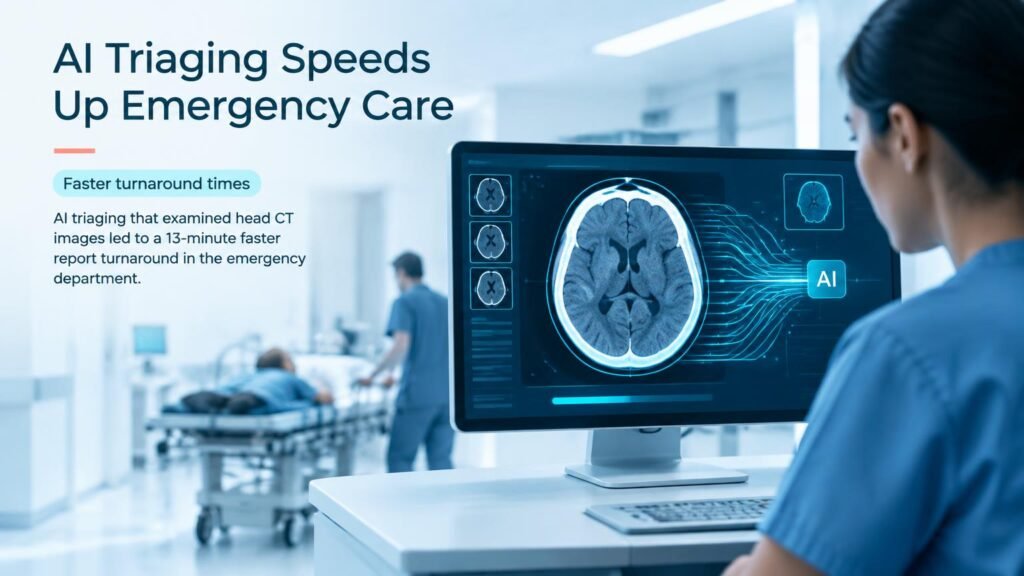
An extra 100 minutes in an emergency room hallway can mean the difference between recovery and permanent neurological damage. A multi-site study of over 20,000 emergency encounters at the University of Washington showed that AI triaging for intracranial hemorrhage reduced report turnaround times by 13 minutes.
The real shift happened downstream in hospital logistics.
Beyond Diagnostic Accuracy
Patients with AI-positive head CTs reached a hospital bed in a median of 423.5 minutes compared to 523.0 minutes for AI-negative cases. While the system achieved 79.3% sensitivity and 94.2% specificity, its primary value was operational reprioritization. Radiologists read scans in 201 minutes down from 214 minutes.
Faster reading directly triggered faster clinical care management.
The Operational Reality
A sensitivity of 79.3% means the model misses roughly one in five positive cases during initial automated triaging. It cannot replace human review. However, as an automated queue management tool, it successfully forces critical cases to the top of crowded emergency department workflows.