 Yusuf Yesil, MD, MIS
An emergency room tool that rarely misses a broken hip sounds like an instant win for exhausted call shifts. Yet high sensitivity comes with a operational cost when false alarms flood the review queue.
That balance is the core challenge highlighted in a new study from Skeletal Radiology. Researchers evaluated the Milvue SmartUrgences AI model on 539 consecutive emergency department patients aged 60 and older across two hospital centers. The cohort had a mean age of 83.4 years, and 66% were female.
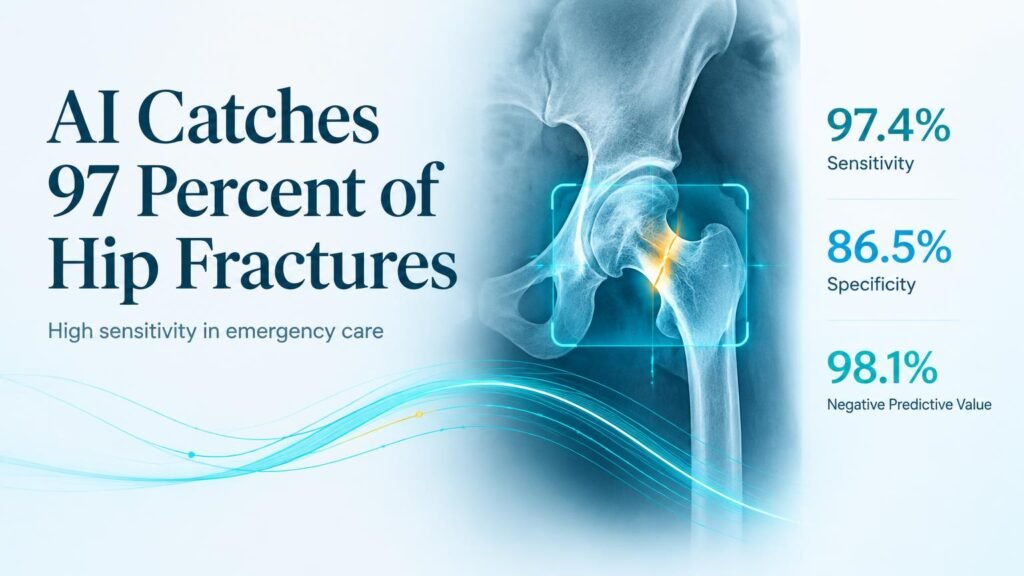
For the 487 patients who received a definitive classification, the algorithm detected 97.4% of the 191 true hip fractures confirmed by expert consensus. It achieved a negative predictive value of 98.1%, confirming its strength as a reliable rule-out tool.
Key diagnostic metrics
- Sensitivity: 97.4% for detecting acute fractures
- Specificity: 86.5% across non-fracture cases
- Negative Predictive Value: 98.1%
- Positive Predictive Value: 82.3%
- Overall Diagnostic Accuracy: 90.8% (F1-score 89.2%)
Rule-out tool, not autonomous diagnostic
The high negative predictive value makes this software an effective safety net for ruling out fractures before discharge. But the specificity of 86.5% creates a distinct burden on clinical teams.
With a positive predictive value of 82.3%, roughly one out of every six fracture alerts is a false positive. If clinicians treat these outputs as definitive, radiology queues will fill with unnecessary secondary reviews and delayed dispositions.
This dynamic reflects broader evidence in automated fracture detection. A systematic review of hip fracture algorithms showed similar performance patterns, where models regularly prioritize sensitivity over precision. Direct clinical validation studies comparing AI to physicians reinforce that computer vision tools work best alongside human decision-makers rather than operating independently.
Workflow limits and next steps
Crucial limitations narrow how these results apply to real-world operations. The primary analysis excluded 52 patients categorized by the AI as “DOUBT,” a grey zone that clinical teams must still manage manually. Furthermore, retrospective diagnostic accuracy on past scans is not proof that the tool improves patient outcomes or shortens emergency department stay times.
The practical takeaway is straightforward. Emergency departments can deploy this software to flag subtle fractures that on-call staff might miss. However, health systems must mandate radiologist sign-off on every positive flag to handle the false-positive rate effectively.
Read the full paper in Skeletal Radiology.