
AI medical teams fail on real emergency cases
Splitting medical AI into a team of specialized virtual doctors actually hurts diagnostic accuracy when facing real-world emergency room cases.
For years, AI developers have assumed that giving large language models specific personas—like a cardiologist or a radiologist—and letting them debate would mimic a real hospital board. A new study reveals this setup is built on a misunderstanding. The benefit of AI teams does not come from their specialized roles, and in real emergency rooms, this complex team structure actually backfires.
This challenges the current industry rush toward complex multi-agent systems. While structured debate helps on standardized tests, it fails in the messy reality of acute care.
The illusion of specialization
Researchers tested three setups: a single direct model call, five personas in one context, and those same five roles acting as isolated agents coordinated by a moderator. They ran these configurations with five repeat runs per case across three distinct datasets. These included 87 CPC cases, 406 MedCaseReasoning cases, and 364 real emergency department encounters. An LLM judge, validated against real clinicians, graded the outputs.
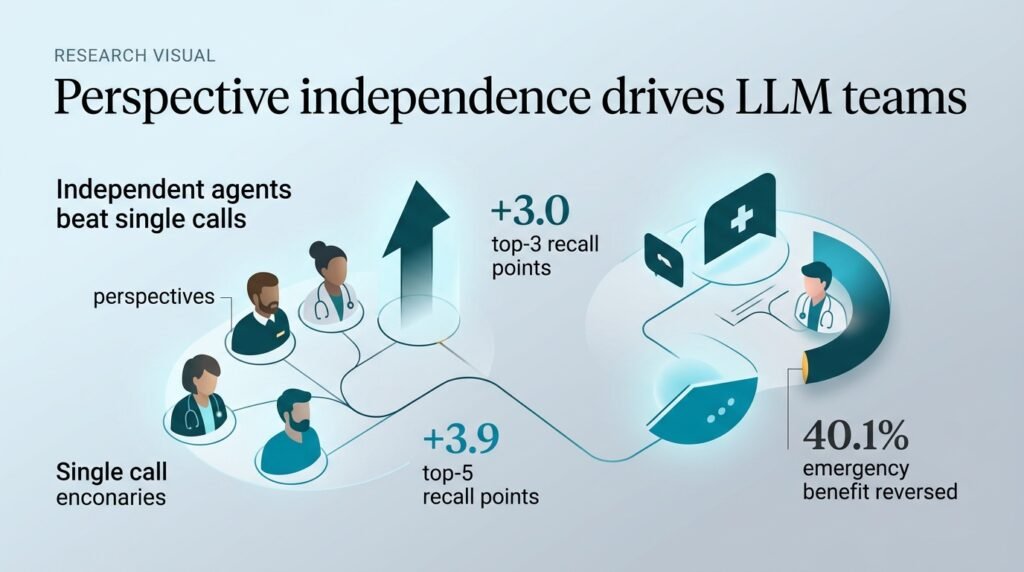
On the external benchmarks, the multi-agent team outperformed the single LLM call. A factorial analysis, however, showed the boost did not come from the clever specialist roles. Instead, the gains came purely from having independent agents generate ideas separately before a moderator synthesized them.
The emergency room reversal
When tested on real emergency presentations, the team dynamic collapsed. The single direct call outperformed the multi-agent team, and the gap was not small.
- Multi-agent teams improved top-3 recall by 3.0 points on standardized benchmarks.
- Top-5 recall increased by 3.9 points on those same tests.
- Single LLM calls beat multi-agent teams in emergency cases, 40.1% to 34.3%.
This performance drop persisted even when researchers added objective clinical results to the prompts. The reversal was carried by the specialist role lists themselves.
This finding is the real story. In high-stakes, messy environments like the emergency department, the noise of multiple specialized agents debating can dilute the signal. The specialist roles likely over-complicated the reasoning process, leading to worse decisions than a single, focused model call.
Rethinking agent design
These findings should make developers rethink the trend of building elaborate virtual clinics. If personas are mostly theater and independent synthesis is the real driver, we are wasting compute on role-play.
We must note the study’s limitations. It relied on an LLM judge, even if validated by clinicians, and used a preprint dataset. Clinical deployment must be tailored strictly to the specific task rather than relying on a one-size-fits-all team structure.
Read the full study on medRxiv.