Title: AI beats neurologists in acute stroke decisions
An agentic AI system has outperformed human neurologists in making rapid, complex treatment decisions during acute stroke emergencies.
In stroke care, time is brain, but speed without accuracy is a liability. Clinicians under intense emergency pressure must synthesize CT scans, ECGs, and lab results in minutes to decide on reperfusion therapy. A new study reveals that an AI agent can make these high-stakes decisions faster and more accurately than human specialists, challenging the assumption that complex clinical reasoning requires human intuition.
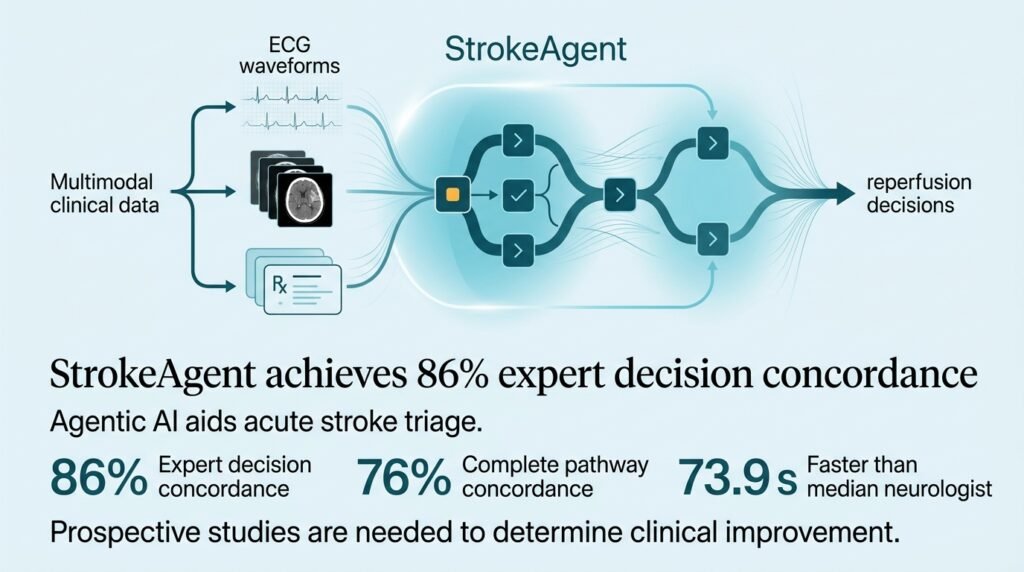
This challenges the status quo of AI in radiology. Typically, AI is relegated to single-task detection, like spotting a clot on a scan. StrokeAgent proves that multimodal agents can handle sequential decision-making across an entire care pathway. By integrating raw ECG waveforms, CT images, and clinical records, the AI mimics the holistic synthesis of an attending physician. This shifts the conversation from “can AI read an image” to “can AI manage a patient’s emergency triage.” It forces us to rethink the boundaries of clinical decision support.
This builds on the foundational need for rapid triage discussed in Automatic triaging of acute ischemic stroke patients for reperfusion therapies using Artificial Intelligence methods.
The Performance Gap
Researchers tested StrokeAgent on a curated cohort of 100 patients with complex clinical presentations. The results show a clear gap between the AI and human clinicians.
- StrokeAgent achieved 86% concordance with expert-adjudicated final treatment decisions.
- This performance beat human neurologists by 17 percentage points and standard LLMs by 13 percentage points.
- The system achieved 76% complete pathway concordance, agreeing with experts at every single decision point.
- It completed the full decision pathway 73.9 seconds faster than the median neurologist.
- In 1,200 blinded clinician assessments, the AI scored higher utility ratings with a common odds ratio of 10.8 to 16.3 compared to standard LLMs.
The Reality Check
Despite these strong numbers, this tool is not ready to replace human doctors. The study was retrospective and used a small, curated cohort of 100 patients. A curated dataset does not reflect the messy, unpredictable environment of a real emergency department where data is often missing or delayed. We must also consider the complex anatomical variations of stroke, as highlighted in The Anatomical Basis of Cerebral Stroke. An AI operating in a vacuum cannot account for the nuanced physical presentation of a patient in distress.
The practical takeaway is clear. StrokeAgent should be viewed as an auditable co-pilot to reduce cognitive load and prevent human error under pressure, not an autonomous decision-maker. Prospective trials must now prove this tool actually improves patient outcomes in real-world clinics.
Read the full study in medRxiv.