

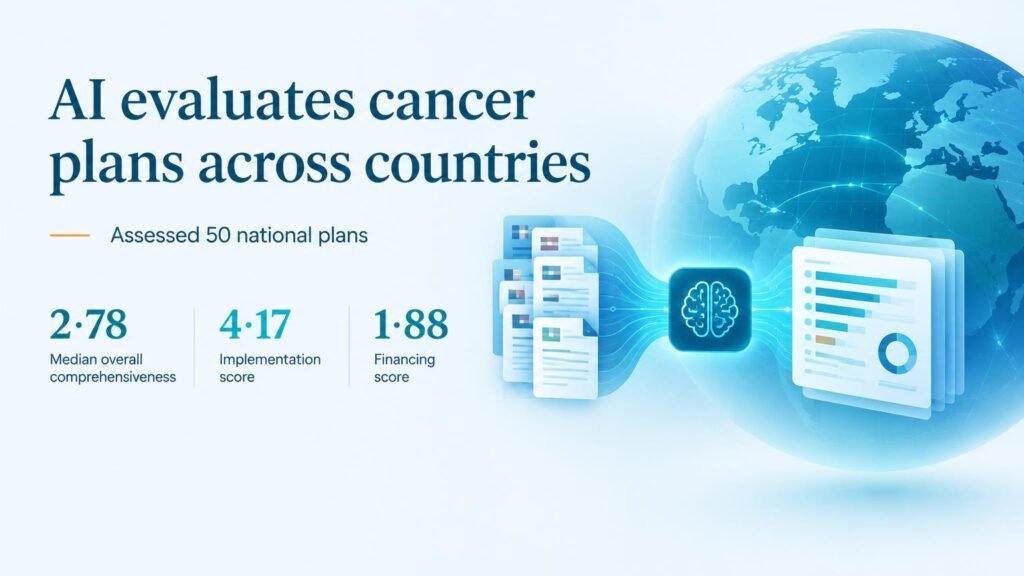
A multiagent AI system audited national cancer control plans across 50 countries, exposing severe gaps in funding and outcome tracking.
National cancer strategies look impressive on paper. Yet when automated software audited official policy documents across 50 nations, it revealed that most plans fail to explain how they will pay for care or track patient survival.
This disconnect challenges the assumption that writing an ambitious cancer policy leads to functional health infrastructure. Without explicit funding lines and clear benchmarks, national targets remain largely theoretical.
Researchers from Harvard University built the Policy Reasoning Integrated Sequential Model (PRISM) to standardize policy evaluation. The system used Qwen2.5-VL-72B for document ingestion and Llama 4 Scout (109B) for retrieval-augmented generation across a 12-element, 76-sub-element framework. A two-stage Delphi process featuring a survey of 67 experts and a 31-participant workshop validated the framework before researchers tested the AI against dual-expert human reviews on six selected plans.
Where national policies fail
Across all 50 reviewed plans, the overall median comprehensiveness score reached just 2.78 on a 0 to 5 scale. That places global policy efforts squarely in the moderate range, with major regional and economic divides.
- Low-income countries logged the lowest median overall score at 2.05 (IQR 1.94-2.22), compared to 2.97 (IQR 2.48-3.15) in lower-middle-income nations.
- The Western Pacific region recorded a median score of 2.21 (IQR 1.78-2.87), lagging behind Europe’s top regional median of 2.96 (IQR 2.78-3.35).
- Implementation scored highest among policy elements at a median of 4.17 (IQR 3.54-4.38), followed by health services at 3.89 (IQR 2.63-4.19) and governance at 3.67 (IQR 3.35-3.98).
- Outcome measurement dropped to a median of 1.83 (IQR 1.33-2.33), while contextual threats averaged 2.19 (IQR 1.72-2.34).
- Financing fell to a median score of 1.88 (IQR 1.00-2.69), with 5 of 11 financing sub-elements scoring 1.0 or less.
The gap in financial planning is the most critical takeaway. Governments regularly outline structural goals and operational logistics, but routinely fail to define how those services will be paid for.
Policy audit limitations
Evaluating document completeness is not the same as measuring clinical success. An AI appraisal of written text cannot verify whether a country delivers quality oncology care on the ground.
The study was limited to 50 active national plans and validated against human reviewers across only six documents. Excluded sub-national strategies, broader health-sector plans, and draft documents mean decentralized health systems might carry more detail in secondary policies than this audit reflects.
Automated multiagent models offer rapid benchmarking across global policy text. However, health ministries must treat these automated scores as a baseline for structural revisions rather than proof of real-world patient care.
Read the full analysis in The Lancet Oncology.