
This week revealed a clear pattern: while algorithms continue to hit diagnostic benchmarks, their real-world value hinges entirely on operational workflow execution and financial incentives.
🔹 AI Predicts Breast Cancer Treatment Response — Multimodal AI models can now identify which breast cancer patients safely skip toxic chemotherapy without risking recurrence.
When I look at this as both a clinician and builder, the software hurdle is trivial compared to the trust threshold required to withhold standard therapy.
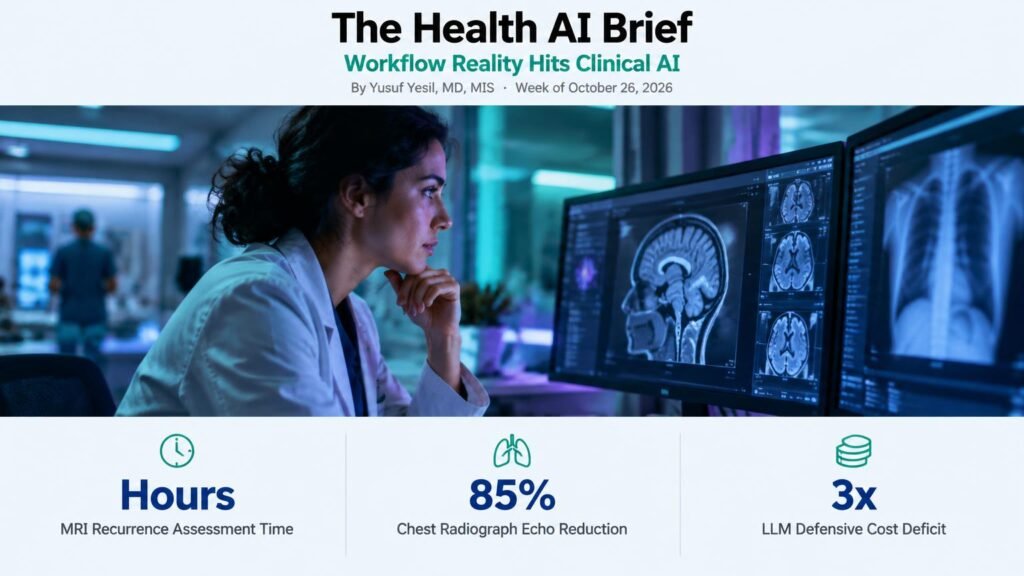
🔹 FDA Clears AI Breast Cancer Recurrence Tool — Oncologists can now assess breast cancer recurrence risk in hours using routine MRI data rather than waiting weeks for tissue testing.
Cutting turnaround times from weeks to hours directly alleviates patient anxiety while fitting smoothly into standard imaging pipelines.
🔹 Generative AI Forgeries Fool Biomedical Experts — Peer reviewers can no longer reliably spot fake biomedical images, exposing a critical vulnerability in scientific publishing.
If our baseline research literature is poisoned by undetectable synthetic data, downstream medical models will inherit invisible failure modes.
🔹 AI Models Curb Low-Value Care Lapses — Large language models usually resist ordering low-value medical tests, but occasional lapses still risk driving unnecessary cascades.
Zero-shot LLMs lack consistent clinical boundary enforcement, making deterministic guardrails essential for any enterprise implementation.
🔹 AI Triage Catches Deterioration But Triggers Alarms — Algorithms spot critically ill emergency patients better than standard triage, but come with a high operational alert tax.
High sensitivity is useless if it causes severe alarm fatigue for nursing staff on busy ED floors.
🔹 Mixed Reality AI Simulations Target Trainee Errors — Interactive 3D overlays and conversational AI are shifting procedural training from static manikins to adaptive feedback.
This is where spatial computing actually makes sense in medicine—accelerating procedural muscle memory before touching real patients.
🔹 AI Face Scans Predict Cancer Survival Risk — A single facial photograph can track biological aging and signal mortality risk in cancer patients.
While technically impressive, introducing computer vision mortality estimates into clinical consultations presents massive communication challenges.
🔹 FDA Clears Twiist Insulin Pump for Type 2 — Automated insulin delivery is moving rapidly into Type 2 diabetes care, shifting daily management to algorithmic control.
Moving closed-loop systems to broader patient demographics proves that consumer-grade software usability is winning in medical devices.
🔹 AI Finds Heart Dysfunction in Chest X-Rays — A deep learning model flags silent heart failure on standard radiographs, potentially cutting unnecessary echo scans by 85 percent.
Repurposing high-volume screening tools like chest X-rays to catch silent disease represents the highest-ROI deployment of opportunistic AI.
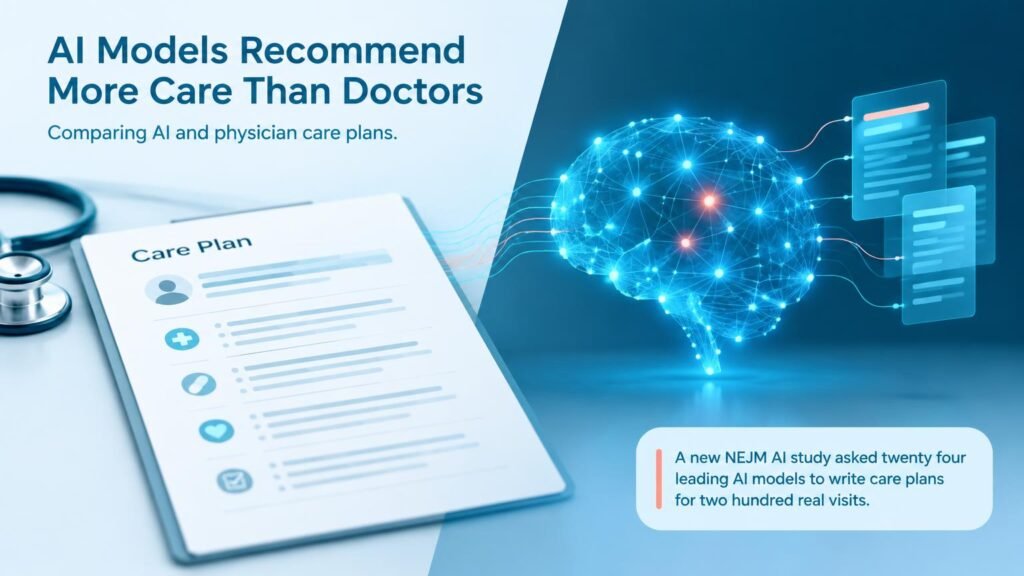
🔹 AI Models Recommend Triple the Medical Costs — Large language models default to expensive defensive medicine, threatening to balloon healthcare spending without improving outcomes.
Until prompt engineering and fine-tuning explicitly penalize unnecessary testing, unguided LLMs will default to maximum liability protection.