

Multimodal AI models can identify which breast cancer patients safely skip toxic chemotherapy without risking recurrence.
De-escalating chemotherapy in HER2-positive early breast cancer spares patients unnecessary toxicity. Yet oncologists lack reliable biomarkers to select who can safely rely on targeted antibody doublets alone. Without accurate stratification, clinicians risk either over-treating low-risk patients or under-treating aggressive tumors.
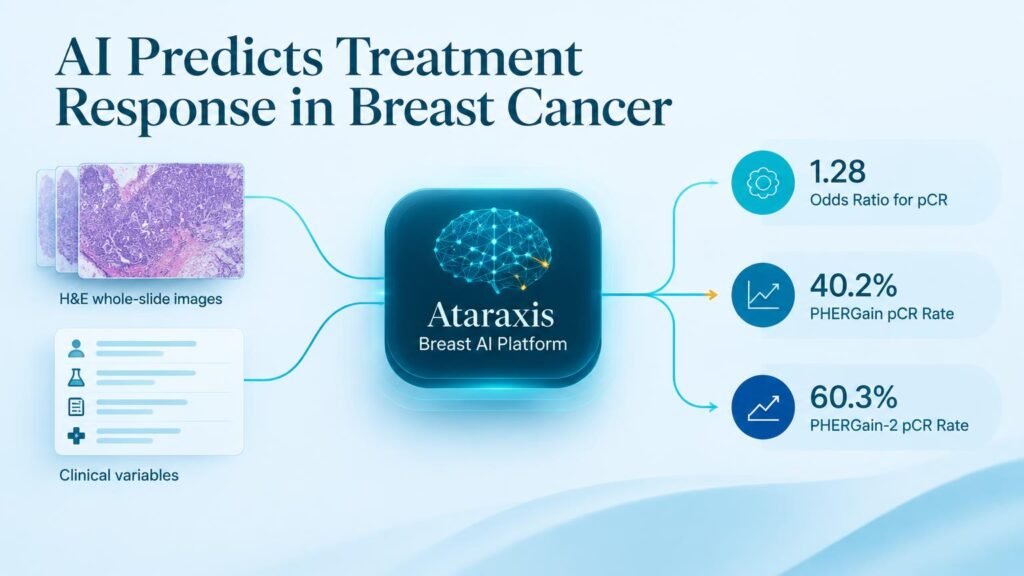
The Ataraxis Breast platform addresses this gap by combining routinely collected hematoxylin-eosin slides with clinical variables. As highlighted in recent research on Advances in Breast Cancer Diagnostics: From Screening to Precision Medicine, combining digital pathology with clinical features is crucial for true precision care. The platform uses two specialized algorithms: ATX NEO to predict pathological complete response and ATX RISK to forecast long-term survival.
Predicting Chemotherapy Response
Validation across two prospective phase II trials shows the model consistently stratifies patient response. In PHERGain, which included 306 evaluable patients, overall response was 40.2%. In PHERGain-2, evaluating 383 patients, overall response reached 60.3%.
Continuous NEO scores were significantly associated with complete response in both PHERGain (OR 1.28; 95% CI 1.11-1.48; P<0.001) and PHERGain-2 (OR 1.30; 95% CI 1.13-1.52; P<0.001). Categorizing patients into prespecified probability groups revealed stark differences in response rates:
- PHERGain response rates rose from 19.2% in low-probability patients to 41.3% in medium and 48.3% in high-probability groups.
- PHERGain-2 response rates climbed from 29.5% in low-probability patients to 61.6% in medium and 70.1% in high-probability groups.
This stratification gives oncologists concrete pre-treatment odds rather than population-level guesses.
Long-Term Risk Prediction
The ATX RISK algorithm evaluated long-term prognosis among 309 evaluable patients in PHERGain. Each standard-deviation increase in the RISK score conferred a higher chance of recurrence (HR 1.56; 95% CI 1.17-2.08; P=0.002). The model achieved a Harrell’s C-index of 0.66.
Patients classified as low risk demonstrated a 5-year event-free survival rate of 93.9%. In contrast, those tagged as high risk experienced an 83.1% 5-year event-free survival rate. Tailoring treatment regimens through multimodal assessment aligns with broader shifts toward Combination Therapy and Nanoparticulate Systems to maximize efficacy while reducing toxic exposure.
Current Limitations and Next Steps
These findings do not mean algorithm predictions can immediately replace clinical judgment. A C-index of 0.66 highlights moderate prognostic accuracy, meaning the risk tool cannot act as a standalone triaging mechanism yet. Furthermore, both evaluations stem from phase II trial populations, requiring prospective phase III validation before changing routine prescribing guidelines.
The practical takeaway is operational. Because the algorithm relies on routine histology slides rather than expensive genomic panels, health systems can implement high-throughput risk stratification at minimal added cost once fully validated.
Read the complete study on medRxiv.