
Clinical AI adoption is accelerating rapidly, yet system integration friction, workflow burn-out, and safety edge cases show that algorithms alone cannot fix broken care pathways.
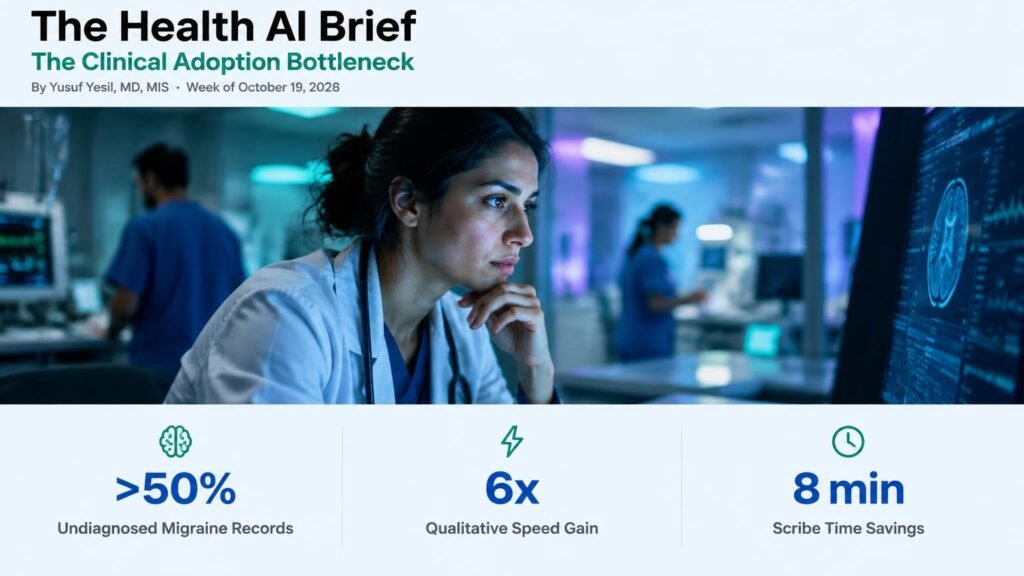
🔹 Hospitals Underdiagnose Migraines While Overusing Scans — Over 50% of Turkish patients receiving migraine treatments lack a recorded diagnosis.
When I review billing codes in clinic, I see this exact gap daily—we jump straight to expensive imaging without logging structured diagnostic terms in the record.
🔹 Fixing Counterfeit Drug Tracking With Digital Standards — Paper tracking allows fake drugs to circulate undetected for months.
Building secure pipelines at Yesil Health taught me that digital tracing is useless until every local pharmacy actually adopts unified API standards.
🔹 AI Speeds Qualitative Research But Misses Patient Depth — LLMs process qualitative health data 6x faster than humans but lack narrative context.
For builders, using LLMs for thematic coding saves massive time, but you cannot rely on them to extract subtle emotional nuances without clinician spot-checks.
🔹 Utah Sandbox Approves AI Prescription Refills — Utah regulators are allowing algorithms to process routine refills to address provider shortages.
This is a pragmatic win for administrative relief, but strict escalation protocols are critical when baseline patient lab values silently drift.
🔹 On-Premise Clinical AI Reaches High Diagnostic Accuracy — On-premise hospital AI safely handles 50% of routine diagnostic cases while protecting privacy.
Local edge deployment solves the compliance headache for enterprise health systems, but maintenance overhead shifts heavily to in-house engineering teams.
🔹 Smart Rings Move Into Medicare Workflows — Medicare Advantage plans are integrating consumer sleep ring data directly into clinical referral pathways.
Connecting consumer wearables to reimbursement models sounds ideal, but it threatens to flood primary care clinics with unvalidated triage alerts.
🔹 AI Therapy Bot Reduces Caregiver Guilt and Fatigue — A single-session conversational AI reduced pediatric caregiver distress while meeting therapeutic standards.
Psychiatric access is severely bottlenecked, and while a bot cannot replace a therapist, accessible low-tier support helps prevent complete caregiver burnout.
🔹 Digital Portals Boost Diversity in Cancer Trials — A digital portal achieved a 40% opt-in rate for sharing sensitive social demographic data.
Patients willingly share sensitive context when the interface feels transparent and accessible rather than like an oppressive intake form.
🔹 AI Speech App Proves Usable for Aphasia — A co-designed mobile app helps expressive aphasia patients turn fragmented speech into clear sentences.
Designing directly with aphasic users creates clean UI patterns that actually work in real-world neuro-rehab settings.
🔹 Doctors Stop Using ED AI As Shifts Progress — Exhausted emergency physicians stop interacting with high-accuracy AI tools as their shift progresses.
If an algorithm requires an extra click during a busy night shift, doctors will ignore it regardless of its underlying benchmark accuracy.