While generative tools often struggle with edge cases, specialized AI models and strategic infrastructure upgrades are delivering tangible speed and diagnostic improvements across hospital workflows this week.
🔹 AI predicts survival for rare unseen cancers — Training on millions of records allows AI to estimate survival for unencountered rare malignancies.
From a developer perspective, sparse data generalization is the ultimate test, but in clinic, I’d still validate these predictions against multidisciplinary tumor boards.
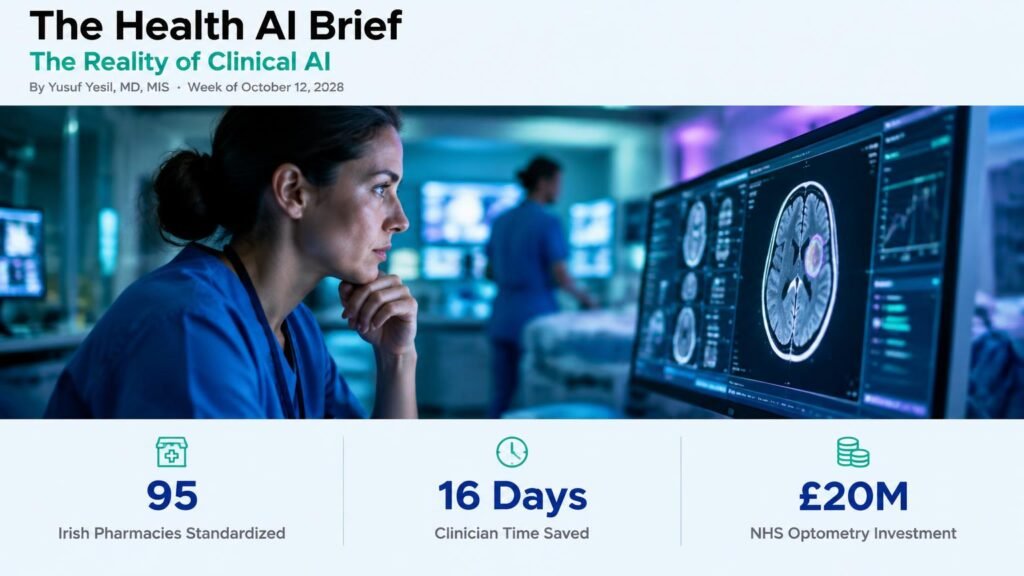
🔹 Standardizing Ireland’s fragmented hospital pharmacy data — Replacing legacy systems across 95 Irish pharmacy departments reveals heavy modernizing friction.
When we built Yesil Health, unifying legacy architecture was always the real bottleneck; software upgrades mean nothing if operations stall during rollout.
🔹 AI helps sonographers spot fetal brain defects — Mid-career sonographers miss fewer fetal anomalies paired with real-time AI without raising false alarms.
This is the ideal sweet spot for point-of-care AI: acting as an active co-pilot that improves sensitivity without adding alarm fatigue.
🔹 Clinicians gain sixteen days but face shadow AI — AI tools claw back nearly 16 days of administrative time, but lack of training breeds unvetted personal tool use.
If hospitals don’t provide enterprise-grade, privacy-compliant AI tools, doctors will inevitably use consumer apps to survive their paperwork.
🔹 DeepSeek Outperforms ChatGPT in Urology Student Trial — Reasoning model DeepSeek R1 outperformed ChatGPT o3-mini on complex urology exams.
Open-weights reasoning models are catching up rapidly, making localized, HIPAA-compliant clinical reasoning far more realistic for builders.
🔹 FDA Clears Stroke Imaging inside Angio Suites — Moving acute stroke imaging directly into the angio suite saves critical minutes in neurovascular intervention.
In acute ischemic stroke, time is brain, and eliminating transit to a separate radiology suite directly impacts functional recovery.
🔹 AI video analysis improves lymph node cancer detection — Analyzing full ultrasound videos rather than static images helps junior radiologists match senior experts.
Dynamic video spatial-temporal modeling captures real-world clinical nuance far better than single-frame classification ever could.
🔹 Government announces £20 million investment into digital referrals — A £20M upgrade links high street optometrists directly to secondary care specialists by 2028.
Direct digital triage paths cut out unnecessary GP middle-steps, drastically reducing secondary care wait times.
🔹 AI agents fail at independent clinical data analysis — LLM agents draft strong research plans but make silent, repetitive coding errors in data analysis.
Never trust an agentic script on raw clinical data without deterministic checks; edge-case errors silently corrupt findings.
🔹 Stockport Replaces 30-Year-Old Pathology System — Stockport NHS Trust replaces a legacy 1992 system across all diagnostic pathology departments.
Upgrading 30-year-old infrastructure is messy work, but modern digital pathology is impossible without a unified database foundation.