Mid-career sonographers miss fewer fetal brain anomalies when paired with real-time AI, without triggering a wave of false alarms.
The diagnostic gap
Ultrasound is notoriously operator-dependent. A missed fetal brain defect during a mid-pregnancy scan can alter a family’s life forever. Yet spotting these rare anomalies requires years of pattern recognition that mid-career clinicians are still developing. This diagnostic vulnerability often leads to delayed management or missed windows for intervention.
This is where the Prenatal Ultrasound Diagnosis Artificial Intelligence Conduct System (PAICS) steps in. A new multicenter trial shows that AI does not need to replace doctors to be useful. Instead, it acts as an immediate safety net for sonographers with three to eight years of experience, catching defects they would otherwise bypass. This shifts the conversation from AI replacing clinicians to AI elevating the clinical baseline.
What the trial found
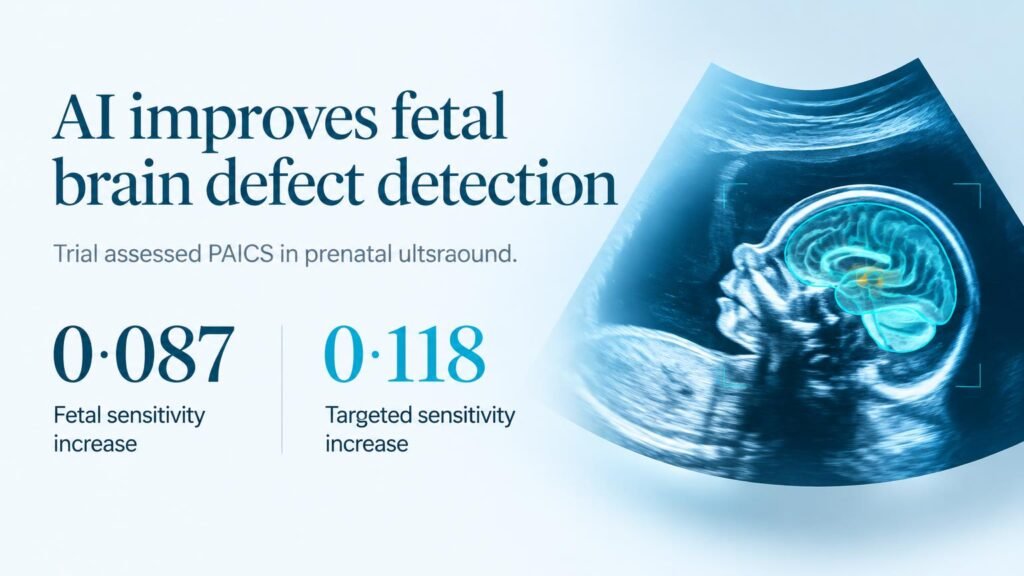
The trial evaluated 1,584 scans of high-risk, single-fetus pregnancies between 11 and 32 weeks of gestation across five Chinese centers. Researchers used a rigorous self-crossover design with a four-week washout period to compare independent human scanning against AI-assisted scanning. The results show a clear diagnostic boost.
- In the fetal-based analysis, AI assistance increased diagnostic sensitivity by 0.087.
- In the malformation-targeted analysis, sensitivity improved by 0.118.
- Specificity remained non-inferior in both analyses, with a negligible difference of 0.009 in the fetal-based cohort.
This means the AI caught significantly more malformations without causing a surge in false positives. It builds on earlier work published in Ultrasound in Obstetrics and Gynecology, which demonstrated AI’s ability to recognize abnormal patterns in standard sonographic planes.
The real-world catch
We must look closely at who this helps. The study specifically targeted sonographers with moderate experience. Highly seasoned experts might not see the same benefit, while complete novices might over-rely on the system.
Furthermore, this trial took place entirely within high-risk clinics. In a standard, low-risk screening population, the prevalence of these anomalies is much lower. This could alter the tool’s real-world predictive value. The study also does not tell us if the AI increased the overall time patients spent on the examination table.
Even with these limits, the operational takeaway is clear. Healthcare networks should view this AI as a training wheels mechanism. Deploying it can rapidly elevate mid-tier staff to expert-level accuracy, stabilizing diagnostic quality across busy clinics.
Read the full study in The Lancet Digital Health.