
A new AI model trained on millions of cancer records can predict survival rates for rare diseases it has never seen before, but only when patient data is scarce.
Oncology models are usually built one cancer at a time. This approach leaves rare diseases in a data desert because there are simply not enough patients to train a reliable predictive model. A new study challenges the assumption that AI must study a specific disease to understand its trajectory. By training on a massive registry of common cancers, a transformer model learned general survival patterns that successfully transferred to rare conditions it had never seen before.
This shift complicates how clinical researchers should allocate their data-gathering budgets. It suggests that massive, generalist pretraining can subsidize the statistical needs of orphan diseases. However, the findings also deliver a reality check for AI enthusiasts. When data is abundant, old-school statistics still reign supreme.
The data foundation
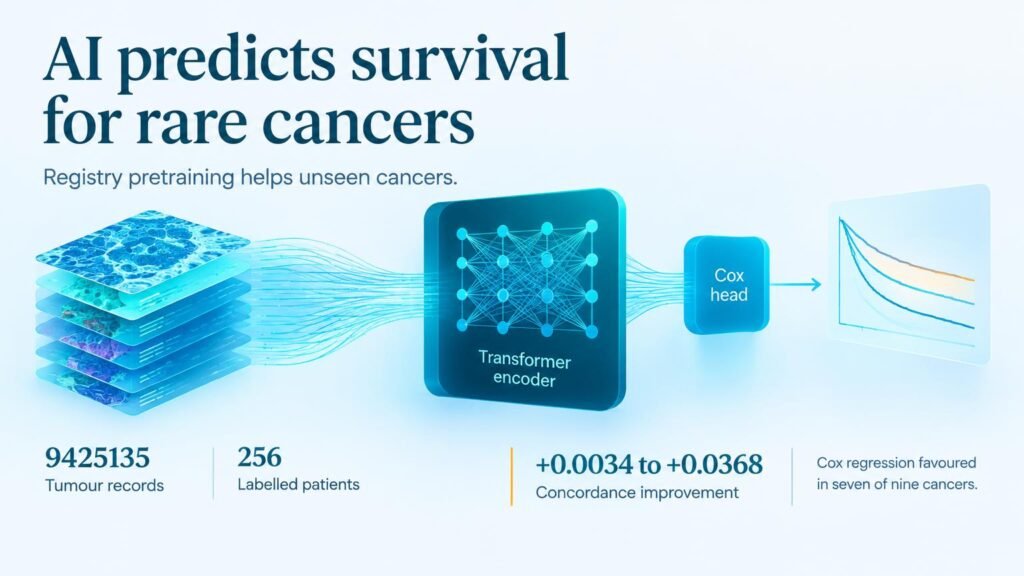
Researchers built their model using 9,425,135 tumor records from the SEER 17 registries, spanning more than two decades from 2000 to 2023. They pretrained a Transformer encoder using masked field-value modeling, intentionally hiding nine rare cancers from the AI during this phase. Once the pretraining was complete, they froze the encoder and attached a simple linear head to predict overall survival.
The goal was to see if the AI could transfer its general knowledge of cancer progression to entirely unfamiliar diseases. The results show a clear advantage in data-starved scenarios, though that advantage quickly evaporates as more patient records become available.
Performance in the data desert
The model proved highly effective when working with extremely small patient cohorts.
- On the nine completely hidden rare cancers, the pretrained model beat a random baseline, improving Harrell concordance by +0.0034 to +0.0368.
- When restricted to just 256 labeled patients, the AI outperformed standard Cox regression across all 67 cancers evaluated, with a median concordance boost of +0.0283.
- When the entire dataset was made available, traditional Cox regression clawed back the lead, outperforming the AI in seven of the nine rare cancers.
The limits of generalist AI
This performance ceiling is the most critical takeaway for clinical operations. The AI is not a superior clinical predictor across the board, but rather a specialized tool for low-data environments. It acts as a statistical bridge for pediatric and orphan diseases that otherwise lack the patient volume for modern predictive modeling.
We must also look closely at the study’s limitations. The encoder did not actually outperform a basic field-frequency baseline on its own pretraining objective. This means the underlying mechanism of how the AI transfers this prognostic signal remains a black box. Furthermore, the study only measures statistical concordance, not actual patient outcomes or clinical utility.
For healthcare systems, this tool should not replace existing clinical guidelines for common cancers. Instead, its immediate value lies in research pipelines for rare diseases, offering a baseline survival model where previously none could be built.
Read the full preprint on medRxiv.