
A quiet migration is underway in clinical machine learning, moving away from resource-heavy, centralized cloud servers and toward the physical edge of care. Medical AI developers are increasingly deploying diagnostic algorithms directly onto low-cost, portable hardware like smartphones and standard microscopes to bypass centralized hospital facilities. This shift is driven by a realization that the ultimate bottleneck in clinical AI is not algorithmic complexity, but the physical and financial infrastructure required to run it.
Where the signal came from
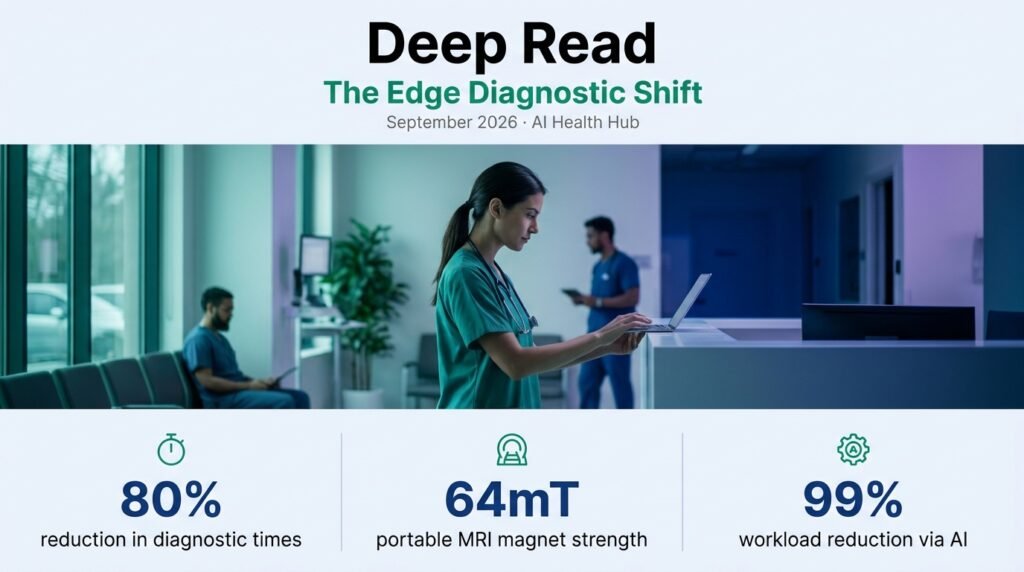
Over the past month, a series of clinical validations and product launches have demonstrated that high-performance diagnostics no longer require high-end laboratory hardware. In clinical pathology, the launch of the MedulAI platform—developed by SpotLab, the Spanish Society for Haematology and Haemotherapy, and GSK—demonstrated that integrating AI with standard microscopes and smartphones could reduce bone marrow analysis times by up to 80% across 14 Spanish hospitals. This was mirrored by the ALLocate system, a cheap hardware plugin that bypasses six-figure digital scanners to bring automated leukemia screening to basic, legacy laboratory microscopes (Cheap AI plugin detects leukemia on standard microscopes).
Simultaneously, researchers have made breakthroughs in low-field imaging and point-of-care testing. A landmark study proved that low-cost, portable 64-millitesla MRI scanners can track multiple sclerosis progression, provided the AI is trained specifically on noisy, low-resolution data rather than pristine 3-Tesla hospital scans (AI measures brain scars on cheap portable MRI). In the field, researchers at Duke University validated a smartphone-based, AI-enabled lateral flow immunoassay platform using quantum dots for quantitative point-of-care diagnostics, while clinical trials of an offline smartphone-based AI platform demonstrated reliable glaucoma screening in low-resource environments without requiring active internet connections.
What’s actually shifting
For the past decade, the prevailing assumption in digital health was that clinical AI would live in the cloud. Developers built massive, multi-modal models designed to ingest terabytes of high-resolution DICOM files and electronic health record (EHR) data. However, this architecture created severe operational bottlenecks: it required expensive whole-slide scanners, high-bandwidth hospital networks, and complex integration with legacy EHR systems. The emerging edge diagnostic paradigm flips this model. By optimizing algorithms to run on consumer-grade chips—such as those found in modern smartphones—and adapting them to noisy, low-resolution inputs, developers are turning ubiquitous physical objects into diagnostic hubs.
This shift is dismantling the traditional gatekeeping of centralized hospital facilities. For example, in developmental medicine, the WISE-Screen tool utilizes standard smartphone cameras to perform eye-tracking screenings for autism at home, bypassing specialist waitlists that frequently exceed a year (Smartphones screen children for autism using eye tracking). Similarly, Makerere University’s Mak Ocular system uses mobile microscopy and AI object detection to scan blood smears for pathogens at the point of care. The fundamental shift is clear: instead of moving the patient or their physical sample to a centralized machine, developers are moving the machine’s intelligence to the patient.
What it means for builders
For clinical AI builders, the mandate is to stop designing exclusively for pristine, high-fidelity data environments. If your algorithm only works on a 3-Tesla MRI or a six-figure digital pathology scanner, your addressable market is restricted to wealthy academic medical centers. Builders must design for the “dirty data” of the real world—noisy smartphone photos, low-field magnetic resonance, and shaky video feeds. This requires investing in edge-native model optimization, quantization, and offline-first architectures.
Furthermore, developers should avoid building standalone software portals that require clinicians to log into a separate screen. As seen in recent clinical trials, doctors actively reject tools that disrupt their physical workflows, even if those tools reduce burnout (Clinicians reject AI tool despite lower burnout). The winning play is to build physical-digital integrations—like hardware plugins or mobile app extensions—that insert diagnostic intelligence directly into the hands of the clinician during the patient encounter.
What it means for health systems
For hospital CIOs and healthcare executives, the rise of edge diagnostics offers a powerful tool to combat the looming capacity crisis. With average hospital occupancy projected to hit 85% by 2032, health systems must find ways to offload routine diagnostic workflows from centralized facilities (Moving AI directly into clinical workflows). By deploying low-cost, portable diagnostic tools to community clinics, urgent care centers, and even patients’ homes, systems can triage patients more effectively and reserve expensive, centralized resources for high-complexity cases.
The contrarian read
The primary risk to the edge diagnostic shift is the “shadow IT” and data privacy vulnerability it introduces. Running clinical-grade AI locally on consumer devices like smartphones and AI PCs creates decentralized data traps for protected health information (PHI), complicating HIPAA compliance (The Hidden HIPAA Risks of AI PCs). If a smartphone-based diagnostic tool stores patient images locally or transmits them over unsecured networks, it creates an unmanageable security perimeter. Furthermore, consumer-grade hardware lacks the calibration standards of centralized laboratory equipment, introducing a high risk of diagnostic drift and liability if a device’s camera or sensor degrades over time.
Bottom line
The future of clinical AI is not locked in a centralized cloud; it is running locally on the cheap, portable hardware already sitting in clinicians’ pockets and community clinics.