A new smartphone eye-tracking tool could bypass long clinic waitlists by screening children for autism at home.
How do you diagnose a developmental condition when the waitlist for a specialist is longer than a year? Families seeking an autism spectrum disorder (ASD) diagnosis face a massive bottleneck. The gold-standard ADOS-2 test requires expensive equipment and highly trained clinicians, leaving thousands of children waiting during critical early intervention windows.
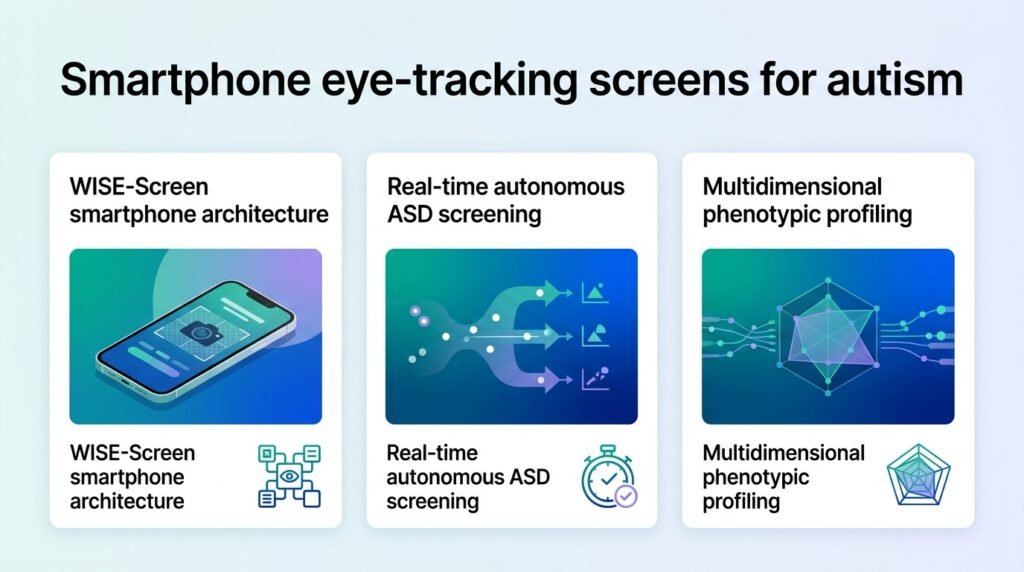
A new preprint introduces WISE-Screen, a smartphone-based tool that turns a standard phone camera into a high-fidelity eye-tracker. This shifts the paradigm of digital phenotyping. Instead of relying on expensive lab-grade infrared cameras, it proves that consumer hardware can capture clinically useful gaze data.
But the real story is not just about cheaper hardware. It is about how we model behavior. The researchers did not just track where kids looked. They split the analysis into two distinct machine-learning pipelines to capture both raw visual habits and specific cognitive responses.
How the system works
The study evaluated the framework on **35 participants** aged **2.5 to 17 years old**, including **16 with confirmed ASD** and **19 non-ASD controls**. To test their gaze, the team used two distinct pipelines. The first analyzed scanpaths across **34 visual stimuli** to map typical gaze probabilities. The second evaluated responses to **17 specialized tasks** across four domains: social, emotional, sensory, and executive functioning.
The performance numbers
The results show a clear improvement over basic demographic screening. While a baseline demographic model achieved an ROC-AUC of **0.82**, the specialized pipelines performed significantly better.
- The scanpath-based pipeline reached an ROC-AUC of **0.90** (95% CI: 0.78-1.00).
- The domain-task pipeline achieved an ROC-AUC of **0.88** (95% CI: 0.75-1.00).
- The fully integrated model peaked at an ROC-AUC of **0.91** (95% CI: 0.80-1.00).
- The age- and sex-residualized models maintained an adjusted ROC-AUC of **0.74** (95% CI: 0.57-0.92).
Triage, not diagnosis
These numbers are impressive, but we must look at the sample size. A cohort of 35 children is tiny. Gaze patterns can vary wildly based on screen lighting, distractions in a home environment, and even the child’s mood that day.
Furthermore, when the researchers adjusted for age and sex, the model’s accuracy dropped to **0.74**. This drop suggests that the AI might still be heavily relying on developmental age rather than pure autism biomarkers. The sensory, social, and emotional domains showed the strongest associations, which aligns with clinical expectations but highlights that executive functioning tasks might need refinement.
This tool is not a replacement for a clinician. Instead, it should be viewed as a triage mechanism. If a five-minute smartphone test can flag high-risk cases with high probability, clinics can prioritize their years-long waitlists to see the most urgent cases first.
Read the full study in medRxiv.