
This week, the shift toward autonomous AI workflow tools reveals a glaring reality: deploying algorithms faster than our clinical governance systems can handle creates massive financial and operational risks.
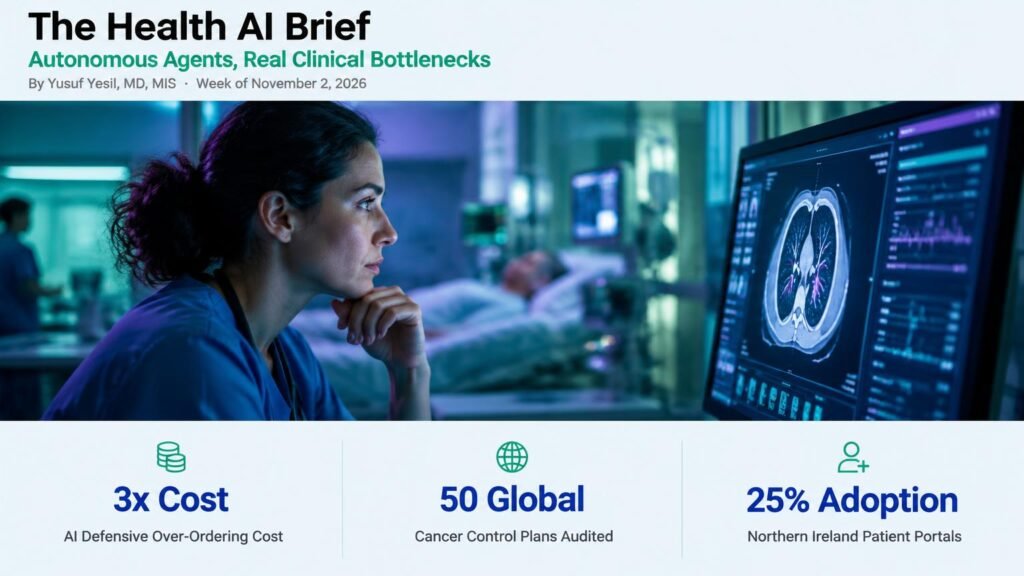
🔹 AI Medical Suggestions Cost Triple Human Doctors — Large language models recommend clinical plans that cost more than triple human orders due to defensive over-testing.
When I was building Yesil Health, defensive prompts were a constant issue; LLMs default to ordering every test to avoid liability, which will destroy hospital budgets if left unchecked.
🔹 AI Evaluated Cancer Plans Across 50 Countries — A multiagent AI system audited national cancer control plans across 50 countries, exposing severe funding gaps.
This is a fantastic use of LLM agents—turning thousands of pages of global public health policy into actionable structured data in minutes.
🔹 Hospitals Face Risks as AI Begins Executing Tasks — Autonomous AI software is executing actions inside healthcare systems before governance frameworks exist.
If you are building in this space, remember that autonomous task execution without hard guardrails is an immediate legal liability for health systems.
🔹 Medical AI Exploits Hardware Signatures To Fake Accuracy — Deep learning models trained on photoacoustic imaging can achieve high diagnostic accuracy simply by identifying the scanner hardware.
This classic shortcut learning issue proves why we cannot trust high validation metrics without rigorous multi-center external validation.
🔹 Doctors Miss AI Errors in Emergency Discharge Summaries — Human oversight fails to catch specific AI errors before emergency discharge papers reach patients.
The human-in-the-loop concept breaks down when exhausted ER clinicians treat AI drafts as accurate, letting subtle errors slip straight to the patient.
🔹 AI Stethoscope Detects Heart Failure Better Than Cardiologists — A digital stethoscope powered by neural networks outperforms expert cardiologists at spotting hidden left ventricular dysfunction.
If you are seeing patients next week, imagine triaging asymptomatic structural heart disease right during a routine physical exam.
🔹 Zocdoc Opens Scheduling Access to Autonomous AI Agents — Zocdoc is inviting autonomous AI agents directly into its scheduling network while major enterprises block them.
Opening consumer scheduling endpoints to AI agents will drastically reduce booking friction, but calendar abuse is going to be a major technical battle.
🔹 AI Spotters Catch Radiology Text Errors in Seconds — A general-purpose AI model caught internal text errors in radiology reports almost ten times faster than human radiologists.
Using fast, light models as automated proofreaders for clinical reports is low-hanging fruit that immediately improves quality control.
🔹 Patient Portal Adoption Hits 25 Percent in Northern Ireland — Patient portals hit 25 percent adoption in Northern Ireland as regional digital record rollouts expand.
Getting a quarter of a population onto a unified portal creates the exact digital foundation required to deploy patient-facing AI tools at scale.
🔹 Symbolic AI Digital Twins Guide Cancer Treatment — Symbolic AI models provide explainable mechanisms for drug combinations in oncology where black-box models fail.
Oncologists will always pick an explainable mechanistic model over a black-box neural network when high-stakes therapy choices are on the line.