

Black-box machine learning models struggle to gain oncologist trust because they cannot explain why a specific drug combination will kill a tumor.
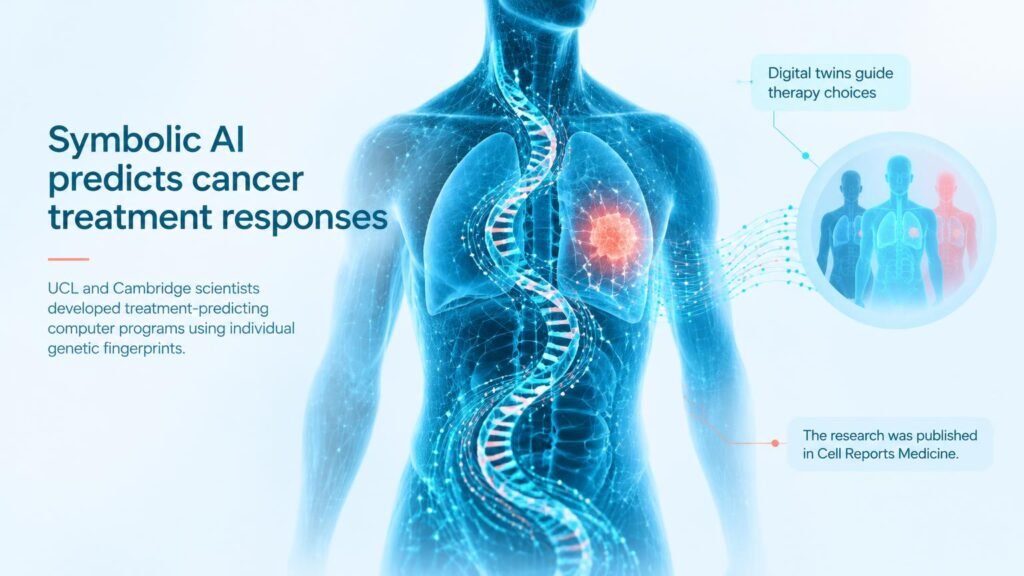
Researchers at University College London and the University of Cambridge built symbolic AI digital twins that use biological logic to map personalized drug responses. Unlike standard deep learning, this approach provides a step-by-step reasoning path that doctors can verify before altering a patient’s care plan.
Predicting Response in Rare Cancers
The team tested the platform on genetic data from 31 patients with triple-negative breast cancer, an aggressive disease accounting for 15% of cases that lacks standard hormonal targets. The digital twins accurately predicted treatment response in 74% of cases within the PARTNER clinical trial dataset.
When standard therapies failed, the model went further. It identified alternative targeted drug combinations tailored to individual genetic fingerprints that could potentially eliminate remaining invasive tumors.
Validation Outside Trial Settings
Accurate retrospective predictions do not guarantee improved survival in a live clinic. The current trial size remains tiny at 31 patients, and synthetic models cannot fully replicate human drug metabolism or real-world drug toxicities.
Translating these digital twins into clinical practice requires prospective trials to prove that AI-guided treatment shifts actually extend progression-free survival without adding unsafe side effects. For now, the model serves as an explainable decision-support tool rather than an automated oncologist.