
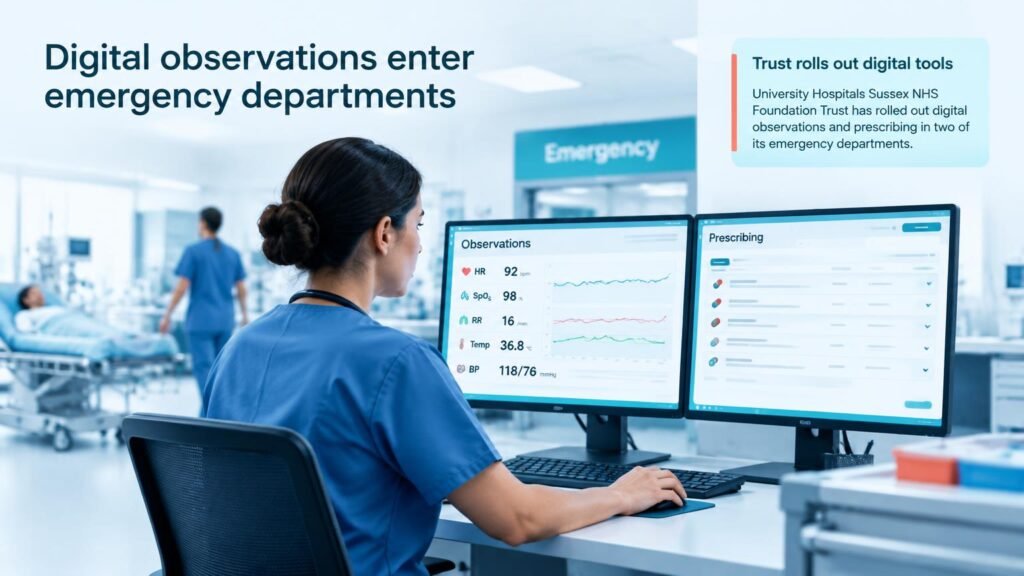
Replacing paper observation charts with real-time digital tracking in high-pressure emergency departments cuts clinical blind spots before patients deteriorate.
Real-Time Tracking
Emergency departments at Princess Royal Hospital and Royal Sussex County Hospital have officially eliminated paper vitals charts. Nurses and doctors now record vital signs and prescribe medications directly into mobile digital systems powered by Alcidion’s Patientrack and System C’s Careflow. The immediate result is automated early-warning alerts triggered the moment a patient starts slipping into sepsis or shock.
Paper charts rely on manual calculation of warning scores. That process breeds human error when staff are managing overcrowded waiting rooms. Digital observations standardize risk scoring across entire shifts.
The Operational Catch
Software does not automatically solve staffing shortages or physical bed crunches. Automated alerts only improve patient safety if clinical teams have the bandwidth to respond to them instantly. Algorithms increase visibility, not capacity.
This emergency department deployment serves as a frontline testing ground. It builds toward a full electronic patient record system planned for 2027 across seven hospitals serving 1.8 million people. Standardizing data input at the point of triage is the only way larger algorithmic monitoring tools will work at scale.