We are finally moving past the era of building models in a vacuum, and the focus has shifted entirely to where the rubber meets the road: clinical integration, safety, and workflow adoption.
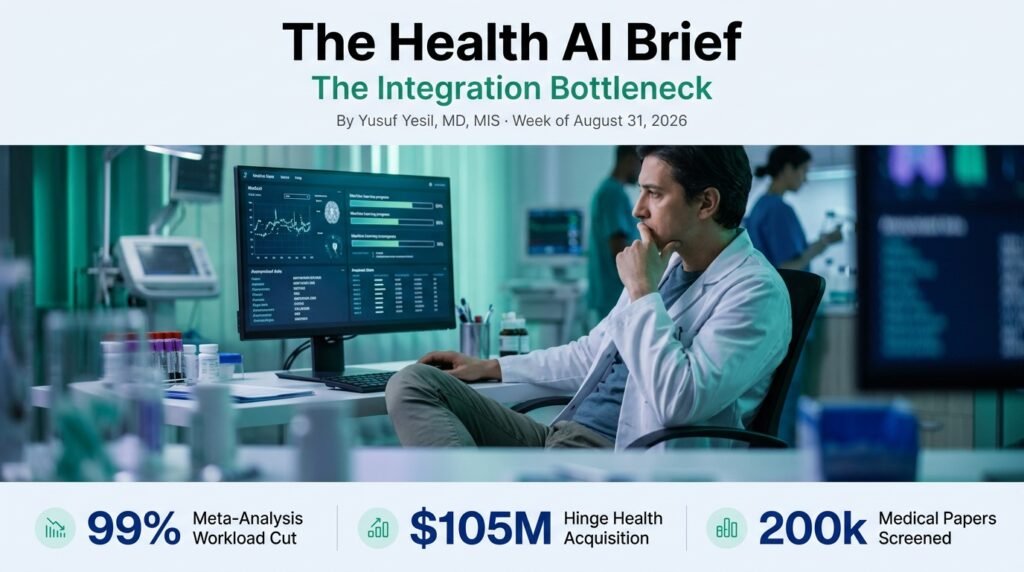
🔹 AI screens 200,000 medical papers for pennies — A new AI screening agent slashed the workload of medical meta-analyses by over 99 percent.
This is a massive win for researchers. When I was building Yesil Health, sorting through literature was a constant bottleneck, and automating this for pennies changes how we generate clinical evidence.
🔹 Hinge Health buys Cylinder for $105 million — Digital health platforms can no longer survive by treating only one pain point.
For builders, this acquisition proves that point solutions are dying; enterprise buyers want a single, integrated platform that handles the whole patient.
🔹 AI changes the meaning of brain signals — Using large language models to clean up brain-computer interface outputs introduces fluent, highly confident lies.
This is a terrifying technical failure mode. If you are building in the neural interface space, you cannot let an LLM hallucinate what a paralyzed patient is trying to say.
🔹 The Hidden HIPAA Risks of AI PCs — Healthcare IT departments deploying AI PCs are unknowingly creating decentralized data traps for protected health information.
If you are seeing patients next week, be careful what you process locally; edge AI is great for speed, but it is a massive compliance headache if data is left unmonitored.
🔹 FDA Approves Self-Updating Cancer Planning AI — Regulators are finally letting medical AI evolve without forcing developers to restart the bureaucratic clock.
This is a massive regulatory milestone that will finally allow clinical models to adapt to real-world drift without years of paperwork.