
Digital health platforms can no longer survive by treating only one pain point.
Employers are exhausted by point-solution fatigue. For years, digital health startups pitched specialized apps for every distinct ailment, forcing human resource departments to manage dozens of disconnected vendors.
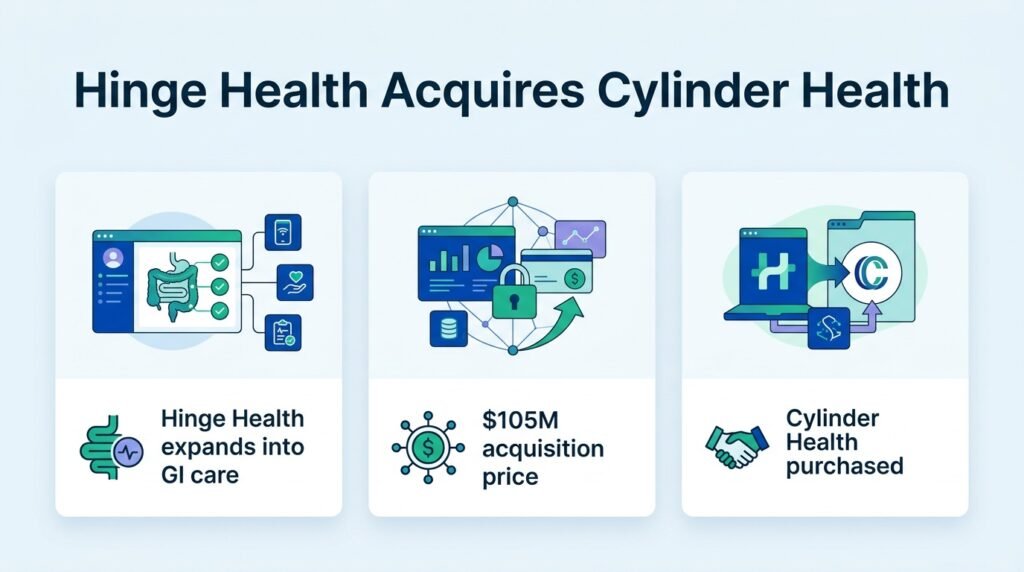
Hinge Health is betting $105 million in cash that the era of the single-issue app is over.
The Consolidation Play
By acquiring Cylinder Health, the musculoskeletal giant is moving directly into gastrointestinal care. This is Hinge’s first major expansion beyond its core orthopedic and migraine programs.
The strategy is clear. Hinge wants to become a single, unified enterprise platform for self-insured employers.
The financial backing is there. Hinge reported a 53% year-over-year revenue jump to $212.8 million in the second quarter of 2026. But integration is rarely seamless. Hinge plans to launch a single, AI-powered app combining these services in 2027.
The Adoption Hurdle
Can one app genuinely manage both chronic back pain and irritable bowel syndrome without losing clinical depth?
The gastrointestinal market is massive, valued at $135 billion. Yet, merging distinct clinical protocols into one digital interface risks diluting the specialized care that made these platforms attractive in the first place. Employers want simplicity, but patients still need deep, targeted expertise.
This acquisition signals a broader industry shift. Point solutions are consolidating because buyers demand unified platforms. To survive, digital health companies must scale up or risk being squeezed out of employer benefit packages entirely.