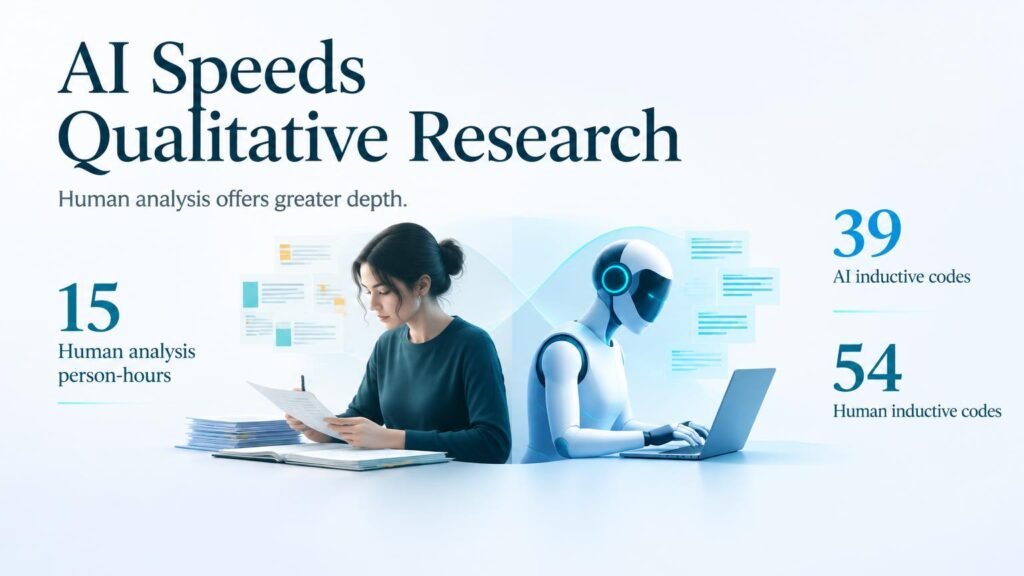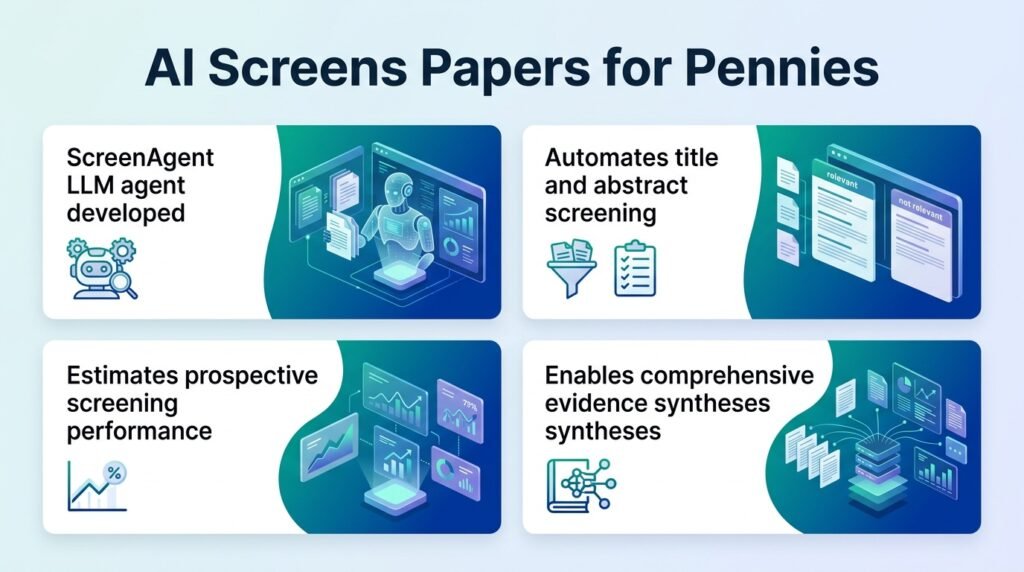
A new AI screening agent slashed the workload of medical meta-analyses by over 99 percent, proving that algorithms can find needle-in-a-haystack medical studies faster and cheaper than humans.
How do you find a hidden link between economic policy and suicide prevention when it is buried in a pile of 200,000 medical papers? For decades, researchers had to manually read thousands of abstracts. This process is so slow that critical public health insights often expire before they reach policymakers.
This bottleneck forces researchers to narrow their searches, often ignoring upstream social factors. That compromise is the real problem. By outsourcing the first pass to an AI agent, we can finally synthesize broad, indirect public health data that was previously too expensive to screen.
The human bottleneck broken
Researchers built ScreenAgent, a large language model agent, and tested it on a massive corpus of 201,064 records. The system processed the entire database for just $855.91, which averages to a mere 0.43 cents per record. This represents a massive shift in the economics of evidence synthesis.
The results show that automation does not require sacrificing quality:
- The agent achieved an internal sensitivity of 97.7%, finding 43 of 44 eligible studies.
- It delivered a 99.4% workload reduction, leaving only a tiny fraction of papers for human review.
- The agent-to-human agreement score (Cohen kappa of 0.75) beat the human-to-human agreement score of 0.64.
- External tests on two published reviews confirmed adaptability, yielding sensitivities of 95.9% and 97.4%.
These findings build on recent research regarding high-performance automated abstract screening. The technology has matured to a point where manual first-pass screening is no longer a defensible use of research hours.
The cost of perfection
However, we must be honest about the risks of automation. ScreenAgent missed one eligible study in the internal validation set. In suicide prevention, missing a single paper could mean overlooking a critical intervention.
This is why a fully autonomous pipeline is still too dangerous. The authors wisely designed a cascade system where a second, higher-effort LLM double-checks the results, keeping humans as the final arbiters. This hybrid approach aligns with the Cochrane Rapid Reviews Methods Group guidelines, which advocate for keeping human experts in the loop to prevent algorithmic bias from skewing medical guidelines.
Ultimately, this tool changes how we define a feasible research question. We no longer have to choose between a narrow, manageable search and a comprehensive, unmanageable one.
This study was originally published in medRxiv.