 Yusuf Yesil, MD, MIS
The Hardware Gap
Algorithms trained on static transvaginal ultrasound datasets claim impressive diagnostic metrics. Some models hit 86.3% accuracy in differentiating benign from malignant ovarian masses, outperforming human experts in controlled retrospective studies. Yet these numbers obscure a critical operational reality: software performance degrades when deployed across different physical scanners and transducer types.
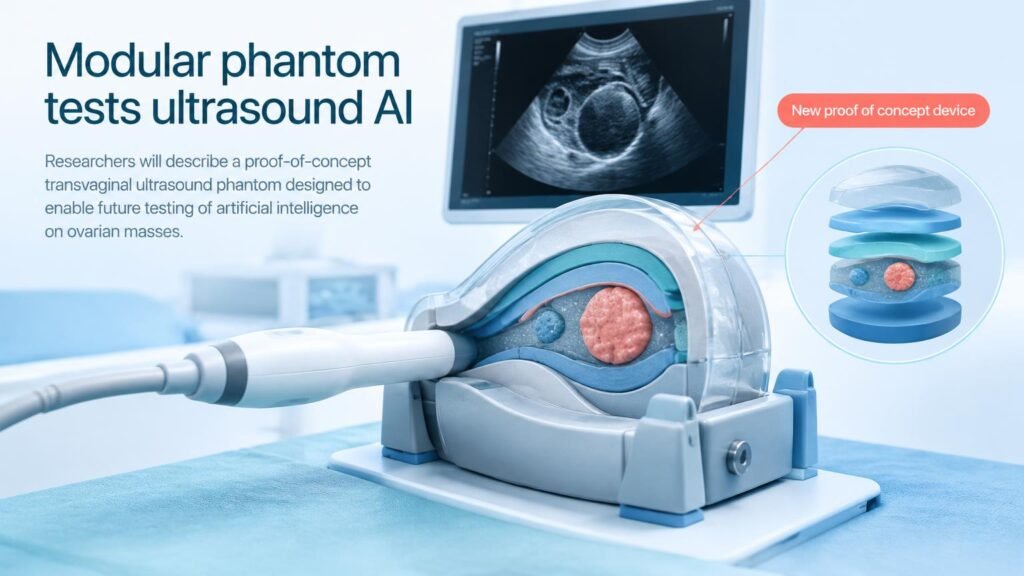
A newly developed modular physical phantom addresses this validation bottleneck. By simulating varied tissue properties and anatomical structures, the phantom creates a standardized environment to stress-test AI models on live diagnostic hardware before clinical deployment.
Beyond Retrospective Claims
Retrospective accuracy does not guarantee clinical readiness. In simulated triage environments, using AI as a secondary reviewer cut unnecessary expert referrals by 63% and reduced misdiagnoses by 18%. However, those gains depend entirely on consistent image capture. Without physical testing tools to calibrate algorithms against hardware drift and operator variability, health systems risk deploying algorithms that fail unpredictable real-world scans.
Standardized physical simulation provides the missing benchmark. Healthcare leaders must demand hardware-integrated phantom validation before integrating algorithmic diagnostic tools into routine clinical workflows.