
Structured counseling data and targeted prompting allow smaller open-source models to perform comparably to human therapists in single-turn dialogue benchmarks.
Giving language models therapeutic conversational skills usually requires massive proprietary architectures. A new study shows that parameter-efficient fine-tuning on structured counseling data closes that performance gap on text benchmarks.
This finding complicates the assumption that safe digital mental health support requires trillion-parameter closed models. By combining domain-specific datasets with structured prompting, compact open-source systems can match licensed professionals in static dialogue evaluations. However, benchmark parity on single turns must not be confused with real-world clinical efficacy.
How YuanChat Was Built
Researchers developed YuanChat using two base models, GLM-4-9B-Chat and Huozi 3.5, fine-tuned with low-rank adaptation. They trained the system on two new Chinese counseling datasets derived from real-world sessions: ECD-3, which holds 104,897 counselor response turns, and Dgold, containing 9,413 manually annotated responses. To refine outputs without retraining, the team added an inference-time framework named E-URIAL that feeds predicted emotion labels and relevant context exemplars directly into the prompt.
Clinical Benchmarks Match Humans
Across both automated scoring and human expert reviews, the multistage alignment process produced dramatic gains over base models.
Key results from the evaluation include:
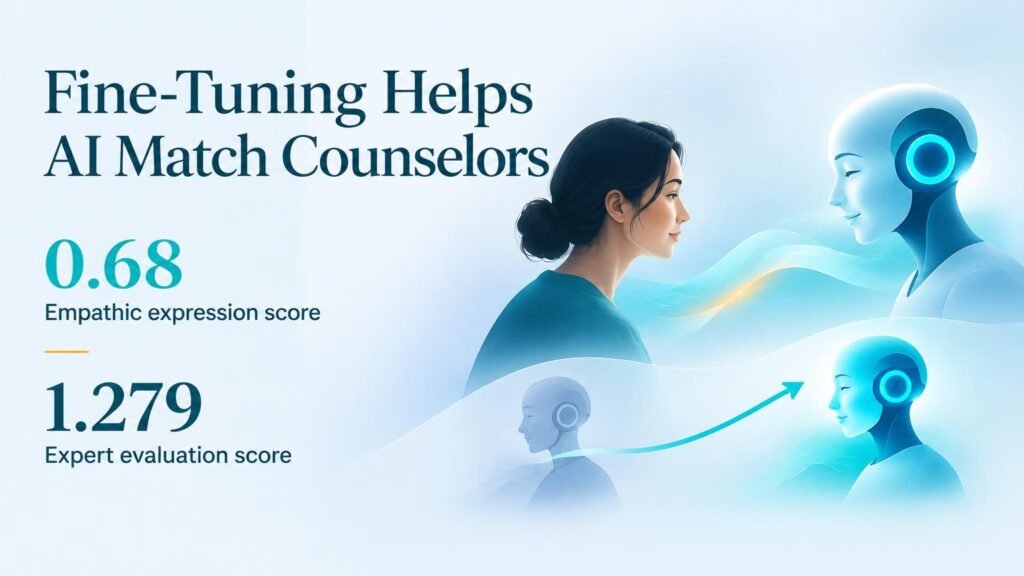
- Fine-tuning increased YuanChat-Huozi3.5’s empathic expression score from 0.57 to 0.68 and empathy identification from 0.54 to 0.59.
- Applying E-URIAL with three exemplars pushed empathy identification to 0.69, empathic expression to 0.79, and perceived helpfulness from 0.61 to 0.74.
- In an expert panel of 8 clinical experts, YuanChat-Huozi3.5 achieved an empathic attunement score of 1.279, compared to 0.327 for the baseline model.
- Expert ratings showed no statistically significant difference between YuanChat-Huozi3.5 and professional counselor responses across attunement, appropriateness, helpfulness, and safety boundary adherence (all Holm-adjusted P ≥ .29).
A secondary trial with 50 master’s students in psychology confirmed strong fluency and helpfulness scores. These findings align with recent work on the psychotherapeutic potential of generative AI, demonstrating that domain-specific annotation can teach smaller models structured supportive strategies.
What This Means for Practice
High benchmark scores do not prove a tool replaces human clinicians. Static text evaluation measures turn-by-turn simulation, not prospective therapeutic alliance, long-term patient recovery, or crisis intervention safety.
As recent critical reviews on artificial empathy and emotional authenticity highlight, simulated attunement can easily break down during unscripted, high-stakes crises. Health systems should view these specialized models as low-cost drafting tools or context-aware intake assistants to reduce clinician workload, rather than direct-to-consumer replacements for human care.
Read the original peer-reviewed study in the Journal of Medical Internet Research.