 Yusuf Yesil, MD, MIS
The documentation bottleneck
Hospital discharge notes are critical for patient handoffs, yet fragmented record systems make manual writing prone to omissions. Doctors often spend hours stitching together admission notes, lab results, and medication changes under heavy pressure. When clinical handoffs are rushed, patient care suffers at the transition home.
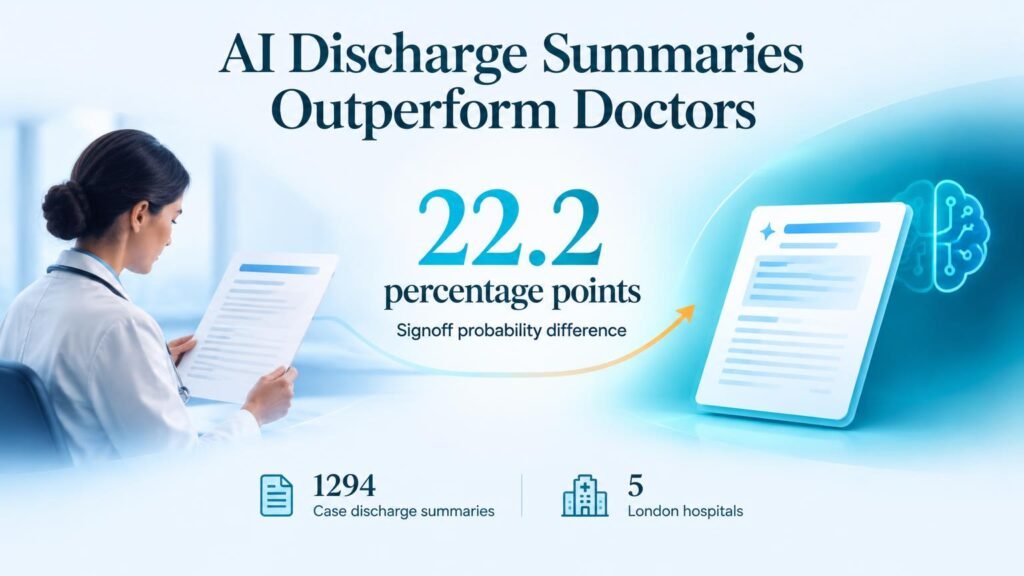
A multi-hospital study across 5 London sites evaluated whether an artificial intelligence model could draft these documents safely. Researchers tested 1,294 case summaries—including 649 clinician-authored notes and 645 model-generated drafts—against full electronic health records across admissions from September 2022 to September 2023. The evaluated cohort had a median age of 46.0 years and a median length of stay of 3.0 days.
The results challenge the belief that automated clinical drafting increases diagnostic error compared to manual entry.
Higher accuracy, lower harm
Using OpenAI’s GPT-4o mini paired with a clinician-codesigned prompt, the AI-generated summaries easily met the prespecified noninferiority boundary. The model achieved a 22.2 percentage point higher probability of clinician signoff with minor or no edits compared to standard physician notes. Secondary scores for accuracy, completeness, tone, and clarity consistently favored the machine-written drafts, with adjusted risk differences ranging from 19.4 to 29.1 percentage points.
Crucially, automated notes carried lower potential safety risks than human-written alternatives:
- Only 26.2% of AI clinical summaries scored 3 or higher for potential harm from missing or incorrect data, compared to 45.1% of clinician notes.
- For requested actions and post-discharge plans, high-harm scores appeared in 26.8% of AI drafts versus 51.5% of human notes.
These findings mirror earlier assessments of automated documentation quality, such as research on physician- and large language model–generated hospital discharge summaries, which similarly noted strong performance against standard human baselines. Related work evaluating AI-generated versus human-written hospital summaries confirms that structured prompt design can mitigate detail loss across complex stays.
Rethinking the standard of care
The standard baseline for discharge notes is remarkably flawed. Hospitalists routinely skip context to save time, introducing errors that downstream general practitioners must untangle. AI drafts provide a comprehensive baseline that human reviewers can verify faster than writing from scratch.
However, high acceptability scores in a retrospective chart review do not equal safe execution without oversight. The trial relied on practicing physicians performing retrospective reviews rather than real-time deployment during live clinical shifts. Furthermore, the median stay was only 3.0 days, leaving open questions about performance on highly complex, multi-week intensive care cases where context windows stretch. Real-world implementation still demands strict human oversight to spot subtle hallucinated facts before notes reach patients.
Read the complete study in JAMA Network Open.