 Yusuf Yesil, MD, MIS
Oncology teams often assume that combining deep learning algorithms with traditional radiomics will automatically yield better clinical predictions. A new study evaluating preoperative contrast-enhanced CT scans proves that assumption wrong. The findings challenge the rushed adoption of complex multimodal AI models when optimized radiomics features already provide exceptional performance.
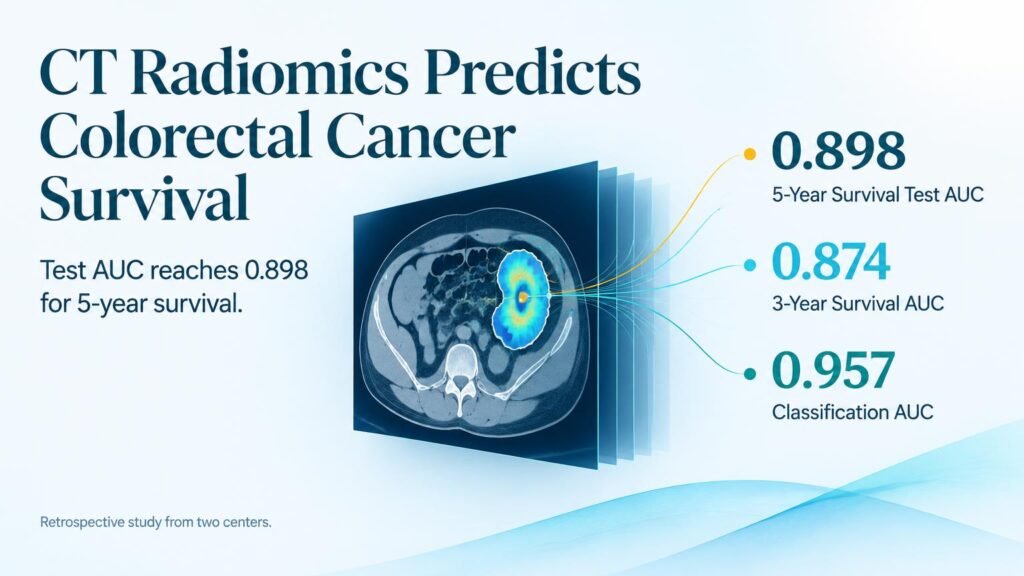
Researchers evaluated 879 participants across two medical centers, including 741 patients with locally advanced colorectal cancer and 138 with benign lesions. Models were trained at Center A on 615 patients and externally validated at Center B on an independent cohort of 264 patients. For distinguishing benign from malignant lesions, a combined clinical-radiomics nomogram demonstrated outstanding generalizability, reaching a test area under the curve (AUC) of 0.957.
Radiomics alone proved sufficient to map long-term patient outcomes without extra computational bloat.
Simple models match multimodal fusion
When forecasting long-term survival, the addition of deep learning early fusion added virtually no diagnostic value over pure radiomics. The performance metrics showed near-identical results across both predictive horizons:
- 3-year overall survival: Radiomics reached an AUC of 0.874, while the multimodal fusion model scored 0.870.
- 5-year overall survival: Radiomics achieved an AUC of 0.898 compared to 0.899 for early fusion.
This narrow margin demonstrates that extra model complexity does not translate to meaningful clinical gains. Radiomics isolated from standard CT imaging offers a robust digital biomarker on its own.
Clinical impact and limitations
These results directly impact hospital workflow and algorithmic validation. Implementing deep learning fusion requires heavier computational infrastructure, higher engineering overhead, and more complex data pipelines. Because radiomics features alone provide an AUC near 0.900 for 5-year survival, clinical engineering teams can deploy lighter, more interpretable tools without sacrificing predictive accuracy.
That conclusion comes with a key caveat. The data was gathered retrospectively across just two medical centers. Retrospective performance does not prove that software improves actual clinician decision-making or patient outcomes in live clinical trials. Prospective trials are still required before replacing established diagnostic workflows.
Read the full study in npj Digital Medicine.