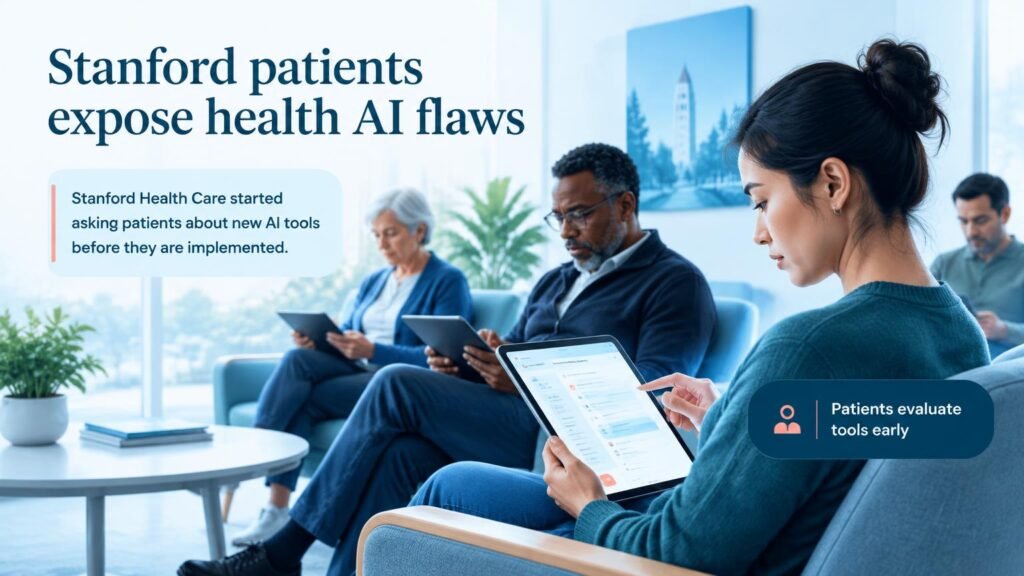
Hospitals deploying clinical AI without patient input risk building tools that break the patient-doctor relationship.
Healthcare executives routinely buy clinical AI based on accuracy metrics and workflow speed. But they are missing a critical point of failure: how patients actually experience these tools.
Stanford Health Care is trying to address this blind spot. Through its Healthcare Ethical Assessment Lab for AI, the system now integrates patients into the governance process before software is deployed.
The Real Friction
Data scientists look at algorithmic drift, while patients look at eye contact.
When patients evaluate AI tools for diagnostics or documentation, their concerns focus on communication and trust. They worry that automated summaries will miss personal nuances, or that screens will replace human connection.
This feedback reveals that technical validation does not equal clinical readiness. An algorithm can be highly accurate, but if it degrades patient trust, it fails operationally. When patients feel alienated by technology, they withhold information or ignore medical advice.
The Governance Gap
The limitation of this approach is scalability. Gathering deep patient feedback is slow and resource-intensive. It cannot match the breakneck speed of software updates.
However, the practical takeaway is clear. Health systems must move beyond purely technical and clinician-led AI committees.
Including patients in governance is not a public relations exercise. It is a risk-mitigation strategy to prevent costly implementation failures. If patients do not trust the tool, they will not trust the care.