 Yusuf Yesil, MD, MIS
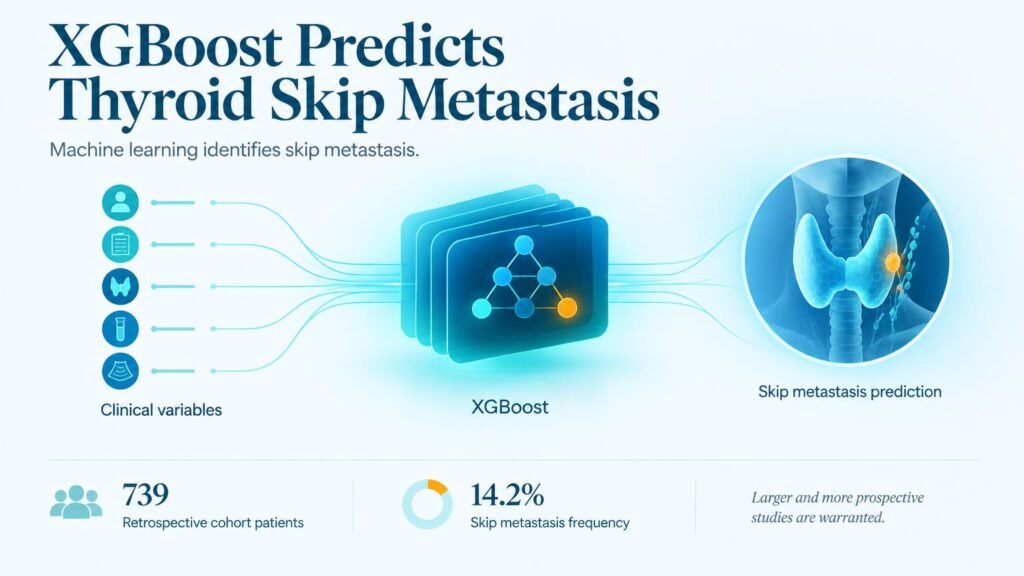
Surgeons operating on papillary thyroid carcinoma normally expect cancer to spread sequentially from central to lateral lymph nodes. But in 14.2% of cases, tumors jump straight to the lateral neck while sparing central nodes completely.
That unpredictable jump creates a costly surgical dilemma. Surgeons must decide whether to remove central nodes prophylactically, risking nerve damage and hypoparathyroidism, or leave them behind and risk missing residual disease.
Earlier efforts tried to map this risk using clinical models and support vector machines or standard nomograms. However, small sample sizes and inconsistent validation hindered wide adoption in surgical planning.
Mapping direct lateral spread
Researchers built and evaluated 10 machine learning models using a primary cohort of 739 N1b papillary thyroid carcinoma patients who underwent routine bilateral central and lateral neck dissections. The team tested the models across internal validation and two independent external cohorts to ensure stability outside the primary hospital setting.
An XGBoost algorithm consistently outperformed competing architectures, delivering superior discrimination and positive net reclassification improvements across both external validation groups.
- 14.2% prevalence of skip metastasis observed across the core 739-patient cohort.
- 10 algorithms trained on routinely collected clinical features.
- 2 external cohorts independently validated model accuracy and risk calibration.
Using SHapley Additive exPlanations (SHAP), the team audited how the software reached its decisions. The total count of dissected central nodes and metastatic lateral nodes served as the most powerful drivers, followed by primary tumor location, patient age, and tumor size.
This interpretability prevents the model from acting as a black box. Surgeons can see exactly which clinical factors drive a high-risk prediction for an individual patient.
What changes for practice
This tool does not replace clinical judgment or prove that altered surgical boundaries improve long-term disease-free survival. Because the study relies on retrospective data, prospective trials are still required before surgeons can safely de-escalate central neck dissections based on model outputs.
That distinction matters for hospital leadership. Diagnostic accuracy on historic charts shows promise, but operational adoption requires proving that AI-guided surgical choices reduce complication rates without increasing recurrence.
Read the complete study in Scientific Reports.