 Yusuf Yesil, MD, MIS
Single-point blood tests offer a static snapshot of an unstable crisis. While clinicians routinely log glucose at entry, a single measurement fails to capture how acute metabolic stress evolves over a patient’s stay. Tracking cumulative glycemic burden over time reveals who is actually failing to stabilize.
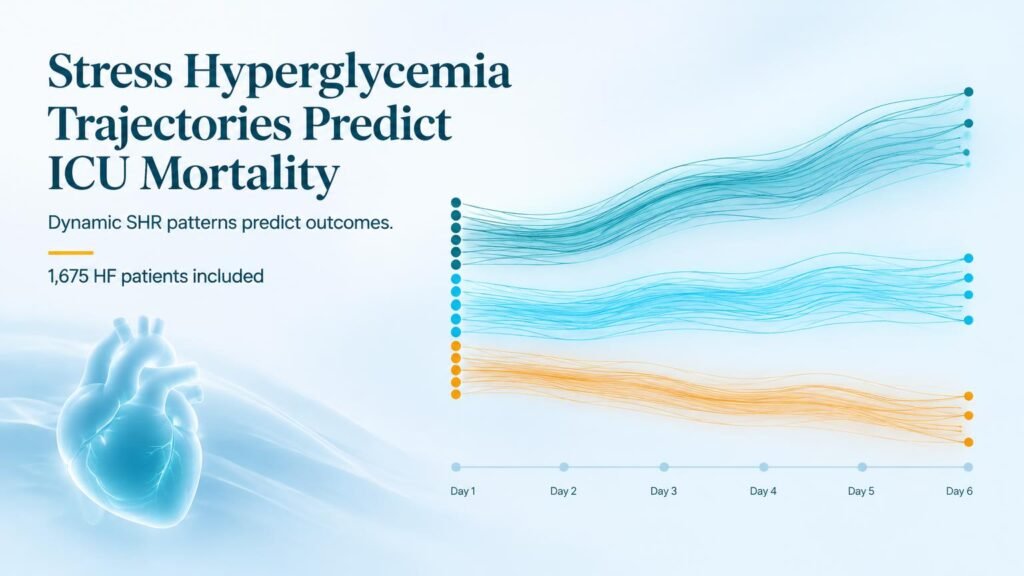
New evidence demonstrates that tracking dynamic trajectories of the stress hyperglycemia ratio (SHR) dramatically improves risk stratification. Researchers analyzed 1,675 adult ICU patients with heart failure using the MIMIC-IV database, validating the approach externally in MIMIC-III. Instead of relying on static admission values, the study tracked SHR trajectories across the first 6 days of intensive care and calculated cumulative SHR (CumSHR) using the trapezoidal rule.
That shift in monitoring completely changes risk assessment in the ICU.
This dynamic approach builds directly on earlier work linking single-point SHR to poor outcomes in critically ill patients with coronary heart disease. However, tracking the full trajectory reveals critical risk patterns that single snapshots obscure entirely.
Tracking dynamic glycemic risk
Latent class growth modeling identified three distinct patient groups over the 6-day window: low-decreasing, moderate-decreasing, and persistently high-increasing. Patients who locked into a persistently elevated trajectory faced the highest risk across all timeframes.
When fed into machine learning algorithms, cumulative metabolic metrics outperformed standard single-time-point indicators:
- Persistently high-increasing SHR trajectories strongly correlated with elevated in-hospital, 28-day, 90-day, and 360-day ICU mortality compared to the low-decreasing cohort.
- Restricted cubic spline models demonstrated a significant linear association between overall CumSHR burden and short- and long-term mortality risk.
- Feature selection via LASSO and Boruta identified CumSHR as a vital input, while XGBoost paired with SHAP analysis ranked CumSHR as the single most important predictor of in-hospital death.
Previous retrospective analyses confirmed that baseline stress hyperglycemia predicts mortality in heart failure. Yet this study proves that dynamic trajectory tracking provides far higher discriminative power than standard admission labs.
From data to the bedside
For intensive care teams, these results mean that real-time algorithmic tracking of blood glucose dynamics could alert clinicians to failing interventions long before traditional clinical decompensation occurs. Replacing static lab cutoffs with automated longitudinal models would allow nursing and medical staff to flag high-risk trajectories without expanding manual workloads.
The reliance on retrospective data from a single multi-hospital database system remains the major operational limitation. Historical EHR databases cannot prove that actively altering a patient’s SHR trajectory via protocolized glycemic control will directly reduce mortality.
ICU clinical decision tools must move away from static admission markers. Predictive algorithms built on longitudinal trajectories provide the actionable signal needed for prospective clinical trials.
Read the full study in Scientific Reports.