
A new agentic framework extracts structured clinical insights from messy medical notes at a fraction of the cost of traditional LLM runs.
Hospital IT departments face a quiet financial crisis. Running massive language models over millions of unstructured electronic health records to predict patient risks is too expensive to scale. Yet relying on cheaper, black-box models leaves clinicians in the dark about how decisions are actually made.
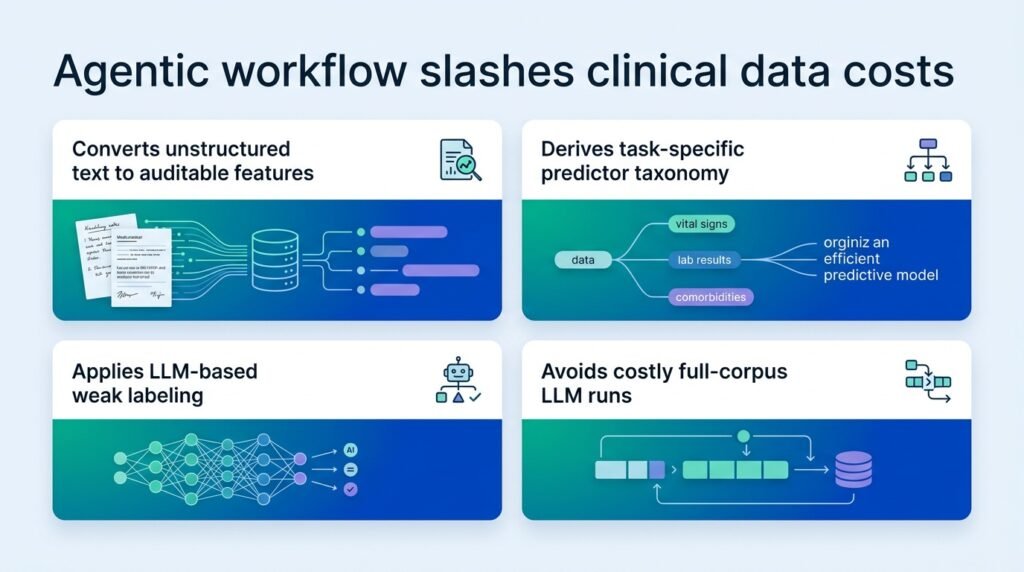
A recent preprint from Vanderbilt University researchers challenges this compromise. By orchestrating a team of specialized AI agents, the team built a pipeline that extracts auditable clinical concepts from free text without running expensive models over every single sentence. This shifts the debate from which model is most powerful to how we can orchestrate cheaper tools smarter.
The power of bottlenecking
Instead of feeding entire medical records into an LLM, the framework uses a multi-agent system to build a “concept bottleneck.” The first two agents define a task-specific taxonomy and weakly label a small sample of text. Local extractors then process the rest of the corpus, and a deterministic builder aggregates the evidence into a clean, traceable timeline.
This architecture means the heavy lifting is done by local, deterministic tools rather than costly API calls. It proves that we do not need giant models to read every line of a chart to get high-quality clinical variables. This structured approach aligns with a broader push toward explainable AI in medicine. Researchers are increasingly using these methods to navigate complex medical databases, as detailed in a study on explainable AI and agentic systems.
The numbers behind savings
The researchers tested their framework on two difficult tasks. The first was predicting medication discontinuation in a longitudinal oncology cohort, where patients frequently change therapies. The second was predicting 30-day readmission using the massive MIMIC-IV database of intensive care unit admissions. When paired with gradient boosting, the new bottleneck layer delivered clear performance gains while keeping costs remarkably low.
- For medication discontinuation, predictive accuracy (AUROC) rose from 0.700 to 0.761.
- For 30-day readmission, AUROC increased from 0.576 to 0.609.
- The system matched the predictive power of BioClinicalBERT, but added a fully traceable audit trail.
- Oncology processing costs dropped to just $24.00, compared to a projected $10,648 for exhaustive LLM processing.
- MIMIC-IV processing costs fell to $23.39, down from a projected $11,519.
The reality check
These savings are impressive, but the system has clear boundaries. The framework still relies on weak labeling during its early stages, which can introduce noise if the initial taxonomy is flawed. It also requires careful setup for each new clinical task, meaning it is not a plug-and-play solution for every hospital department.
Even with these hurdles, the financial argument is hard to ignore. This framework proves that clinical NLP does not require a blank check. By limiting LLM use to a bounded setup phase, healthcare systems can finally build interpretable risk models that they can actually afford to run.
Read the full study in medRxiv.