AI finds where cancer started using blood tests
A new machine learning model can pinpoint the origin of mysterious cancers from simple blood fragments, shifting the focus of liquid biopsies from detection to direction.
Finding cancer in a patient’s blood is no longer the hardest part of oncology. The real crisis is figuring out where the tumor actually started. Without a clear tissue of origin, doctors are forced to prescribe broad, aggressive treatments that often miss the target.
This new study challenges the assumption that we need expensive, deep-sequencing tests to find these answers. By using low-pass whole-genome sequencing, researchers are proving that cheap, shallow data can be highly informative when analyzed through a smart ensemble model. This builds on previous efforts to extract value from shallow sequencing, such as tracking copy number changes in lung cancer cohorts or distinguishing malignant tumors from benign lesions.
How the model works
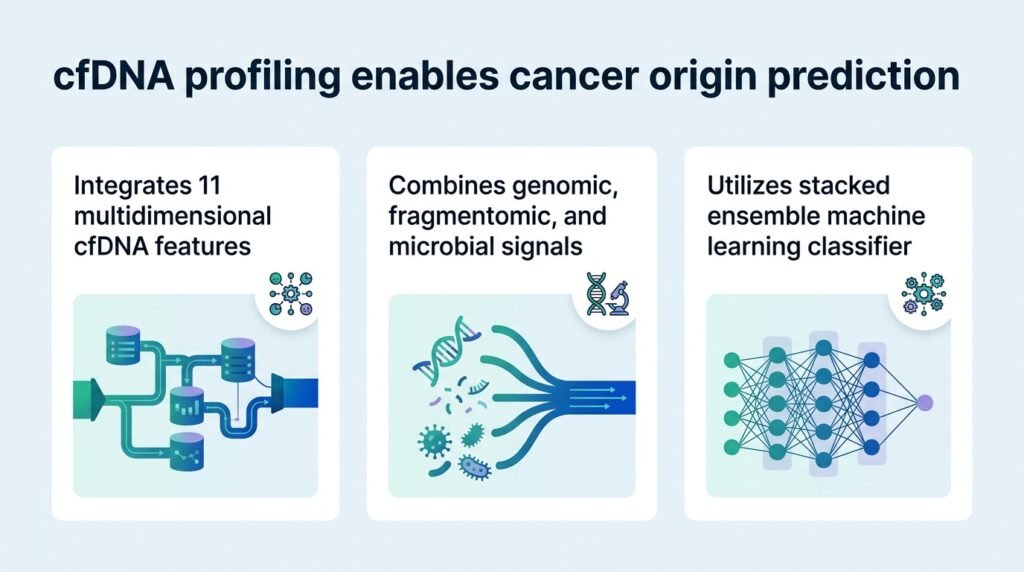
The researchers built a stacked ensemble classifier that combines five different algorithms, including Deep Learning, Distributed Random Forest, Gradient Boosting Machine, Generalized Linear Model, and XGBoost. Instead of looking at just one signal, it integrates 11 multidimensional cell-free DNA (cfDNA) features. The model relies heavily on physical characteristics like nucleosome positioning, fragment size distribution, and repeat elements rather than just searching for specific genetic mutations.
The performance data
The model was trained on a cohort of 1,814 patients and tested on an independent validation group of 1,221 patients across 17 cancer types.
- Training cohort accuracy reached 78% for top-1 and 89% for top-2 predictions.
- Validation cohort accuracy held steady at 80% for top-1 and 90% for top-2.
- In samples with a low tumor fraction, the model still achieved 71% top-1 and 85% top-2 accuracy.
- For cancers of unknown primary (CUP), the model correctly predicted the origin in 11 of 15 cases (73.3%).
The clinical catch
The tool is not equally sharp for every disease. Performance peaked in head, neck, and colorectal cancers, but lagged in other tumor types. Furthermore, a sample size of 15 CUP cases is far too small to declare clinical readiness.
This approach shifts the liquid biopsy debate. It proves that fragmentomics—the study of how DNA breaks apart in the bloodstream—is a highly viable diagnostic signal. If larger clinical trials validate these findings, oncology may finally move away from invasive tissue biopsies for hard-to-locate tumors.
This research was published in Molecular Biomedicine.