Doctors spend hours typing notes after their shifts end, but automating real-time chart completion could finally end the pajama-time documentation crisis.
The administrative burden of electronic health records has long been a primary driver of clinical burnout. Doctors routinely face hours of tedious data entry long after their clinical shifts end. This administrative friction does not just exhaust staff; it delays care coordination.
But a structural shift is happening.
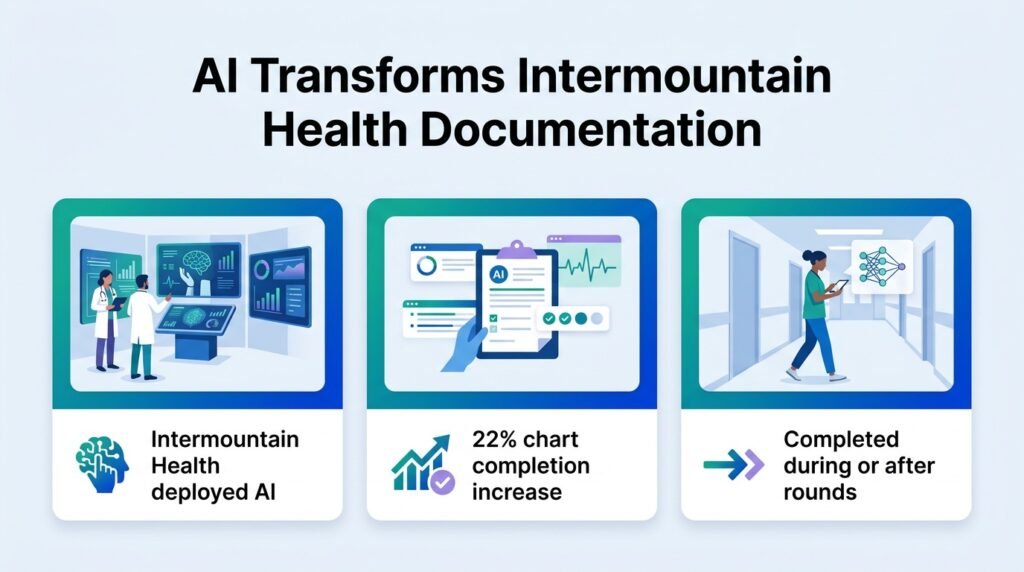
By integrating ambient AI tools directly into the clinical workflow, one major health system achieved a 22% point increase in inpatient chart completion during or immediately after patient rounds. This is not just about saving time. It fundamentally changes how clinical data flows through a hospital.
The Real-Time Shift
Waiting until the end of a shift to document care introduces memory decay and coding delays. Real-time capture ensures the clinical narrative is recorded when it is freshest. Intermountain Health achieved this by deploying Microsoft’s Dragon Copilot to over 2,500 active users alongside 3M’s M*Modal CDI Engage One.
The operational impact is clear. The health system saw its Net EHR Experience Score jump by 11.5 points. This proves that clinicians do not hate technology itself. They hate technology that gets in their way.
Beyond the Keyboard
When health systems reduce the cognitive burden of paperwork, they free up mental bandwidth for actual care. This documentation push aligns with a broader clinical strategy. The same system utilized AI-driven monitoring for chronic conditions like COPD, resulting in a 50% drop in hospitalizations.
However, scaling these tools requires caution. Ambient AI relies heavily on speech recognition and structured data extraction. If models misinterpret clinical nuance, billing and coding errors could spike. Health systems must balance speed with rigorous human oversight to ensure accuracy is not sacrificed for convenience.