Simply handing generative AI tools to exhausted physicians will not solve the healthcare burnout crisis, and for some overworked doctors, it may actually make things worse.
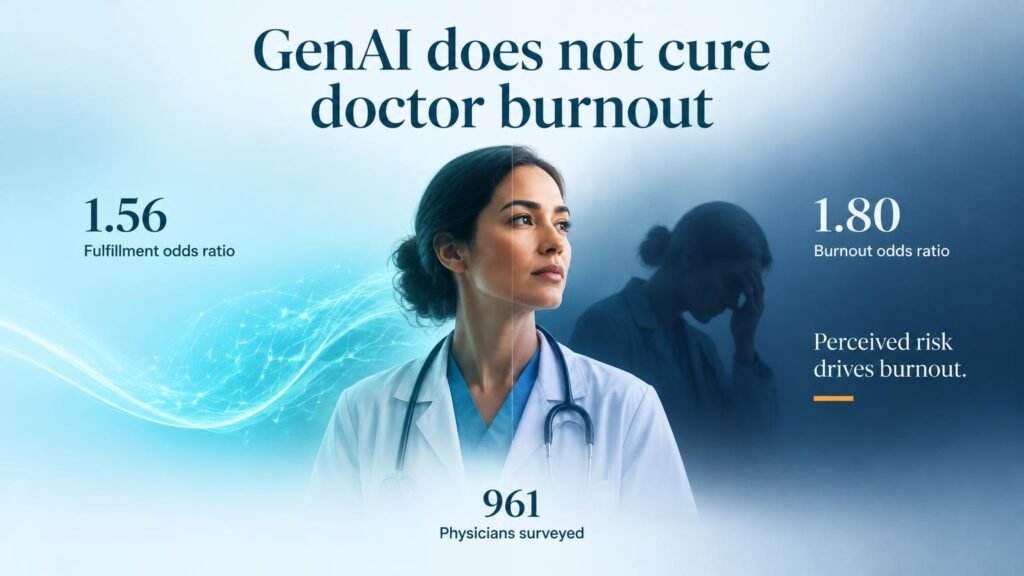
Hospital administrators often pitch generative AI as a quick fix for clinical exhaustion. But a multiregional study of 961 Chinese physicians reveals a troubling disconnect. Simply using the technology more frequently does not reduce burnout. Instead, the psychological burden of double-checking AI outputs and navigating legal gray zones is actively driving clinician stress.
This challenges the naive assumption that more tech equals less work. AI adoption is a psychological transition, not just a software installation. When clinicians perceive high risk in these tools, their burnout risk spikes. This finding aligns with global trends. A 2026 study on U.S. provider perspectives on GenAI highlighted that successful integration depends heavily on trust and clear operational boundaries. When those boundaries are blurry, the mental load of verifying AI work offsets any time saved. Clinicians end up doing the work twice: once to generate the draft, and once to audit it for dangerous hallucinations.
What the data shows
The researchers combined survey data from 961 physicians across four Chinese regions with 10 in-depth qualitative interviews. The quantitative analysis revealed that usage frequency alone has no direct correlation with burnout. Instead, the impact depends entirely on how physicians perceive the tool’s utility and risks.
- Perceived usefulness was associated with a 56% increase in professional fulfillment (OR 1.56, 95% CI 1.17-2.08; P=.003).
- Perceived risk was associated with an 80% increase in the likelihood of burnout (OR 1.80, 95% CI 1.46-2.21; P<.001).
- For doctors working three or more night shifts a week, using generative AI was tied to a 13.96-fold increase in burnout odds (95% CI 2.40-81.04; P=.003).
The qualitative interviews clarified these numbers. While AI can boost professional fulfillment by improving self-efficacy, it also introduces “verification fatigue.” Doctors feel forced to constantly audit AI-generated text because the legal boundaries of responsibility remain undefined.
The verification fatigue trap
This study has clear limitations. The cross-sectional design means we cannot prove that AI usage directly causes burnout. Furthermore, the massive 13.96 odds ratio for night-shift workers is highly imprecise, as indicated by the wide confidence interval. This finding likely reflects a small, already overwhelmed subgroup of clinicians rather than a universal rule.
However, the practical takeaway for healthcare leaders is urgent. Measuring AI success by adoption rates is a mistake. If a tool requires constant, stressful oversight, it is not saving labor. Hospitals must establish clear legal frameworks to protect clinicians before deploying these tools. Without these guardrails, generative AI will remain a source of anxiety rather than aid.
Read the full study in the Journal of Medical Internet Research.