

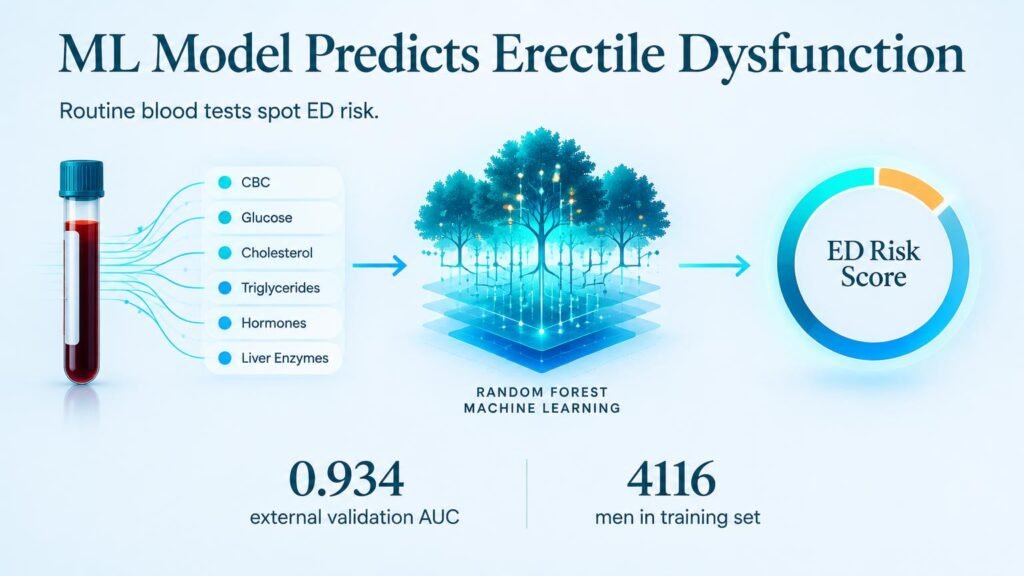
A nine-marker blood test model can flag erectile dysfunction without subjective questionnaires or invasive exams.
Erectile dysfunction often serves as an early signal for underlying cardiovascular disease. Yet patients rarely report it early, and clinicians lack quick, objective screening tools during routine check-ups. Instead of relying on self-reported survey scores, a new study turns standard lab panels into an automated diagnostic signal.
Researchers pulled data from 4,116 men in the NHANES (2001–2004) dataset to build and train their algorithms. They tested 49 initial demographic and blood markers before narrowing the panel down to nine key features. To prove the algorithm works in the real world, they tested it on an independent group of 489 clinical patients whose condition was confirmed by nocturnal penile tumescence and rigidity testing.
A sharp leap in accuracy
Traditional statistical methods struggle to catch complex metabolic interactions in standard lab work. Machine learning bridges that gap by identifying non-linear patterns across common blood metrics. This approach follows broader efforts to build diagnostic tools from biochemical panels, such as earlier work on interpretable machine-learning diagnostic models for erectile dysfunction.
In the independent external validation cohort, the random forest model outperformed traditional methods across every major metric:
- External validation area under the curve (AUC) reached 0.934, compared to 0.743 for standard logistic regression.
- Overall diagnostic accuracy hit 0.918 in the clinical cohort.
- Specificity reached 0.986, minimizing false positives in real-world screening.
Feature interpretation via SHAP values revealed that age, sex hormone-binding globulin, testosterone, glucose, cholesterol, and creatinine drove the model’s predictions most strongly. This links the software’s decisions directly to well-known metabolic and vascular markers.
What changes for clinical care
The operational takeaway is clear. Health systems do not need expensive specialized testing to flag at-risk men during routine annual check-ups. Existing lab results can run through an automated layer to alert doctors before patients even bring up symptoms.
This builds on previous population-level efforts, such as prediction models using NHANES data. However, high retrospective accuracy does not mean software replaces clinical judgment. Retrospective validation proves algorithmic correlation, not improved patient outcomes or reduced doctor workloads.
The primary limitation stems from the external validation set size. While 489 patients validated the software in a hospital setting, prospective clinical trials are still required to measure whether automated flags actually lead to earlier treatment or better cardiovascular outcomes. Until then, the model serves as an intelligent triaging filter rather than a standalone diagnostic tool.
Read the full study in Andrology.