
A new five-gene signature identified by machine learning links CD8+ T-cell exhaustion directly to poor survival and immunotherapy failure in colorectal cancer.
Most patients with colorectal cancer gain little to no benefit from standard immune checkpoint blockade. Oncologists have long struggled to separate responders from non-responders before starting expensive, invasive treatments. This failure points to a deeper issue: current biomarkers overlook how T cells burn out inside the tumor microenvironment.
That diagnostic gap may be closing.
A study published in BMC Cancer used multi-omics machine learning to track how functional T cells transition into an exhausted state. By identifying a distinct continuous spectrum of CD8+ T-cell exhaustion, researchers constructed a risk model that isolates why certain tumors resist treatment. The analytical framework moves the field past static cell counts toward real-time functional profiling.
Mapping the Five-Gene Signature
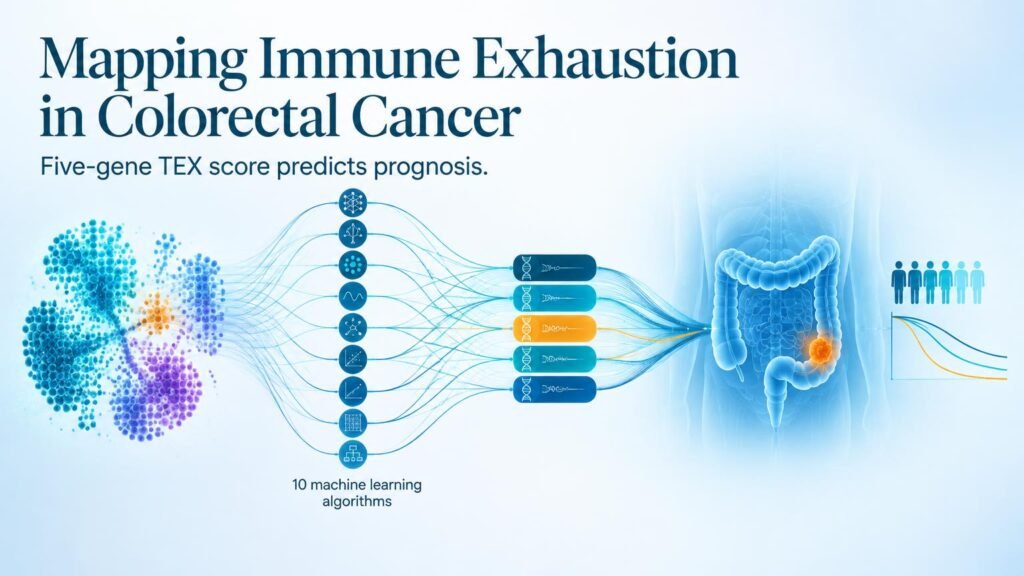
To pinpoint the drivers of immune decay, researchers combined single-cell RNA sequencing with bulk transcriptomic datasets. They evaluated cell states using high-dimensional weighted gene co-expression network analysis (hdWGCNA) alongside ten machine learning algorithms. The computational pipeline narrowed thousands of candidates down to a core five-gene panel: KLF3, LMNA, SLC2A3, ARL4C, and TIMP1.
The resulting T-cell exhaustion (TEX) score predicted both poor survival outcomes and an aggressive, immunosuppressive microenvironment across independent validation cohorts. Laboratory validation using RT-qPCR, Western blot, and quantitative multiplex immunofluorescence confirmed that these five markers physically co-localize with CD8+ T cells in human tissue samples.
This biological mechanism aligns with earlier research published in Cancer Immunology Research, which demonstrated that the ratio of exhausted to infiltrating lymphocytes dictates patient outcomes. Similar single-cell computational approaches in Functional & Integrative Genomics have also highlighted the prognostic power of exhaustion-related genes in solid tumors.
Key Findings and Validation
- Identified a five-gene signature (KLF3, LMNA, SLC2A3, ARL4C, TIMP1) that correlates with immunotherapeutic resistance.
- Screened features using ten machine learning algorithms paired with single-cell and bulk transcriptomic data.
- Validated target gene expression and spatial co-localization via multiplex immunofluorescence and RT-qPCR in clinical specimens.
Translational Stakes and Limitations
For oncologists, a transcriptomic signature offers a practical tool to stratify patients before committing to anti-PD-1 or anti-PD-L1 therapies. Identifying an immunosuppressive niche early allows clinicians to route non-responding candidates toward alternative clinical trials or combination regimens without wasting critical care windows.
However, retrospective models do not equal clinical utility. The study relies heavily on archived computational cohorts and tissue biopsies, meaning it cannot prove that selecting patients based on this TEX score improves real-world overall survival. Prospective clinical trials must confirm whether matching treatment strategies to this five-gene panel actually extends lives.
Until prospective interventional data exists, this model serves as a precise stratifier rather than a standalone clinical decision engine. It outlines the specific cellular mechanics of immune evasion, giving drug developers clear target pathways to overcome resistance.
Read the full study in BMC Cancer.