The FDA is quietly rewriting the economics of genetic medicine by letting developers reuse safety data across different drugs.
For years, biotech startups have faced a grueling regulatory paradox. If you design a brilliant delivery vehicle—like a lipid nanoparticle—to carry a gene editor to the liver, you must prove its safety from scratch for every single disease you target. This repetitive testing drains capital and stalls pipelines.
The Platform Shortcut
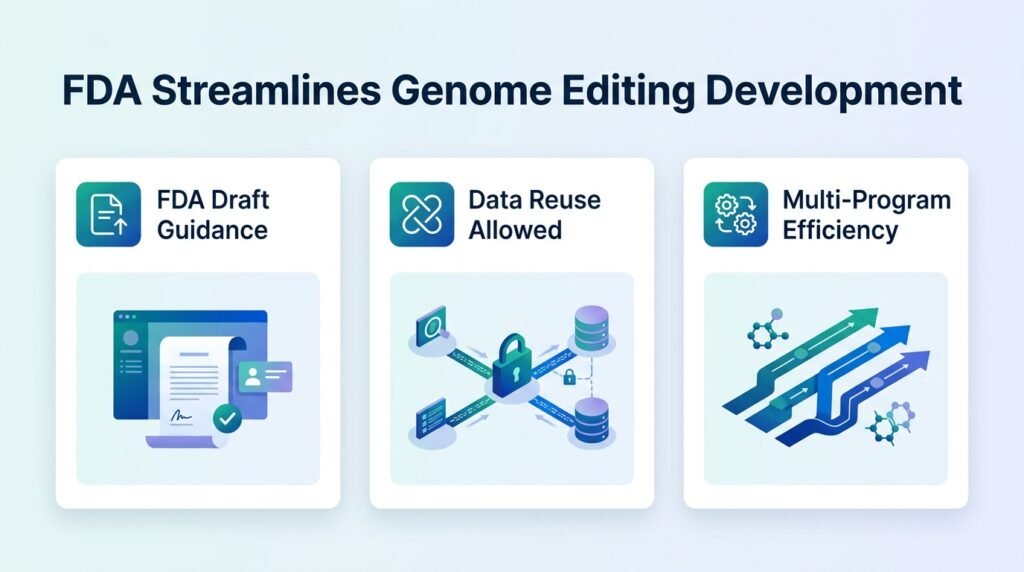
The FDA’s new draft guidance changes the math. Developers can now reuse chemistry, manufacturing, and controls (CMC) alongside nonclinical and clinical data across multiple programs.
This means a company can establish a trusted delivery platform once, then swap out the genetic payload for different diseases without repeating basic safety trials. It is a pragmatic shift toward treating gene editing more like software and less like bespoke chemistry. Crucially, developers do not even need a formal platform technology designation to benefit.
The Risk Trade-off
This policy is a lifeline for capital-constrained startups. By bypassing redundant testing, smaller longevity and rare-disease companies can stretch their funding much further. It lowers the barrier to entry for niche therapies that otherwise would never see the light of day.
But this efficiency introduces a new kind of vulnerability. If a platform’s delivery mechanism reveals a systemic flaw late in a clinical trial, every drug built on that platform could instantly crumble. By allowing data reuse, the FDA is trading redundant paperwork for concentrated systemic risk. Developers must now ensure their foundational platform data is flawless, because a single failure could trigger a multi-pipeline collapse.