
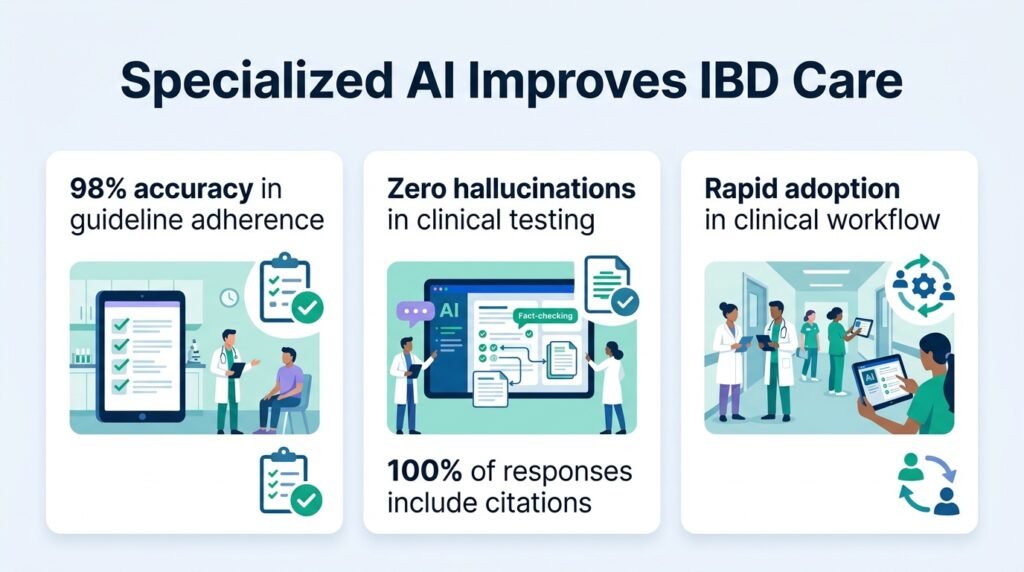
A new clinical trial shows that doctors will actually use generative AI in daily practice, provided it is chained to strict medical guidelines rather than the open web.
Can we trust generative AI when a patient’s gut health is on the line? Most clinicians say no, fearing the unpredictable hallucinations of general-purpose models. Yet a new study of ChatIBD suggests that narrowing an AI’s focus to a curated library of medical guidelines can bypass this trust gap.
This shift from “all-knowing” models to hyper-focused, bounded search engines challenges the current obsession with building ever-larger systems. For specialized medicine, smaller and restricted is safer and more useful. It proves that clinicians do not want a creative partner. They want a fast, reliable index. This aligns with broader efforts to utilize generative tools for unstructured clinical data, as seen in inflammatory bowel disease research.
How doctors used the tool
During its first six months of live deployment, ChatIBD registered 913 users who sent 7,222 messages across 3,855 conversations. The tool operated globally, drawing activity from 69 countries and in 28 languages, though the highest message volumes came from the United Kingdom at 27.1% and Spain at 12.3%. Doctors used the platform primarily during working hours, with 85.1% of messages submitted on weekdays and a median daily volume of 35.5 messages. This pattern suggests the tool was integrated directly into clinical workflows rather than treated as a novel curiosity.
- Medication-related queries emerged as the single largest use domain.
- Synthesizing complex clinical guidelines was the most frequent user intent.
- The system recorded 16 explicit feedback events, including one negative rating that triggered a system change.
The limits of early adoption
We must look closely at what this study does not prove. The authors openly admit this evaluation does not establish response accuracy, safety, or actual clinical effectiveness. It only proves that busy doctors will repeatedly log into a specialized tool if it promises to simplify their workflow.
This rapid international uptake highlights a growing tension in the biopolitics of health data, a challenge recently explored in the future of gastroenterology. If we deploy these tools globally before formal clinical validation is complete, we risk automating subtle diagnostic errors at scale. Feasibility is not the same as safety.
Why the design matters
ChatIBD succeeded in gaining traction because of its guardrails, not its freedom. It uses retrieval-augmented generation (RAG) to force the AI to answer only from a curated corpus of inflammatory bowel disease guidelines. By hardcoding medication dosing information from the European Medicines Agency, the developers built a digital safety net. This is the blueprint for future clinical AI: restrict the model, cite the sources, and let human clinicians flag the errors.
Read the full study in medRxiv.