
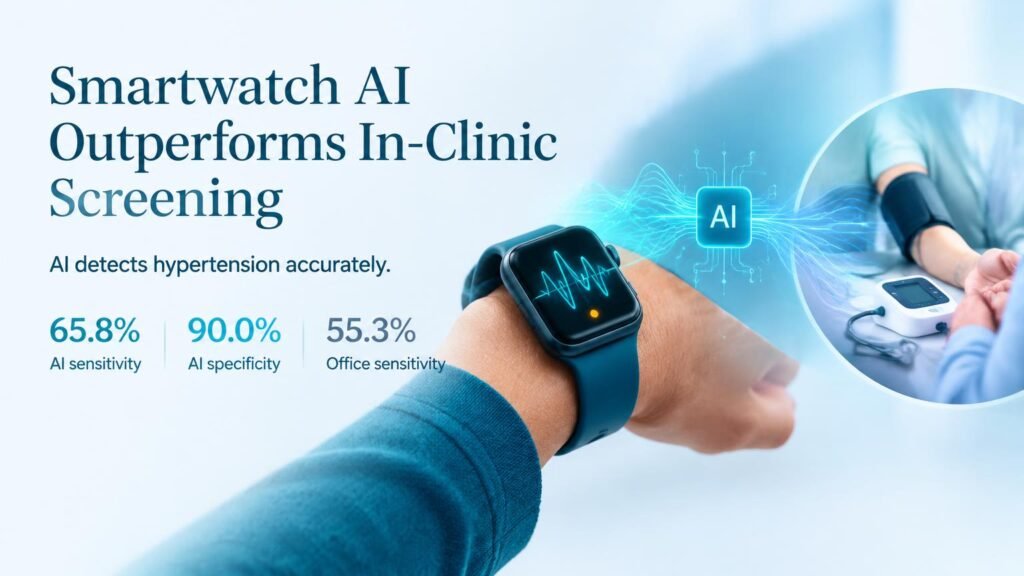
Passive optical sensors on consumer smartwatches can flag undiagnosed high blood pressure without cuff calibration.
A quick arm-cuff check at the doctor’s office misses nearly half of all hypertension cases. Over half of affected adults do not know they have high blood pressure, leaving them exposed to unexpected strokes and heart attacks. Continuous wrist monitoring offers a direct way to catch these silent risks during daily life.
This finding shifts how health systems should view wearable tech. Instead of replacing clinical instruments, passive smartwatch tracking acts as an automated safety net that outperforms routine single-visit clinic checks. As noted in recent work on blood pressure monitoring via wearable devices, moving from episodic office visits to continuous passive screening addresses a structural failure in primary care.
Better Than Clinic Checks
A prospective multicenter trial tracked 196 diverse participants who had no known cardiovascular disease and took no blood pressure medication. Researchers evaluated an uncalibrated algorithm called AI-PPG-ACC-HTN, which analyzes photoplethysmography and accelerometry signals, against seven days of gold-standard 24-hour ambulatory blood pressure monitoring.
The continuous wrist algorithm caught significantly more cases of high blood pressure than standard in-office screening while matching its low false-alarm rate:
- Smartwatch sensitivity reached 65.8% compared to 55.3% for initial office blood pressure screening.
- Both smartwatch monitoring and office screening achieved a specificity of 90.0%.
- Smartwatch positive predictive value hit 80.6%, exceeding the 77.8% mark seen in office checks.
That 10.5 percentage point boost in sensitivity means fewer high-risk patients slip through the cracks. Broad review of the future of AI in hypertension confirms that passive screening creates a wide funnel to direct unrecognized cases toward formal medical care.
Real Limitations Remain
The software is not a standalone diagnostic tool. A sensitivity of 65.8% still misses over one-third of hypertensive individuals. Furthermore, the trial excluded patients with known cardiovascular disease or active blood pressure prescriptions, so performance in older or sicker cohorts remains unproven.
Smartwatches also capture dynamic arterial changes rather than direct static pressure. Motion artifacts and poor wrist fit can still degrade optical signals during active daily routines.
The Operational Takeaway
Clinicians should treat smartwatch alerts as a trigger for formal diagnostic workups rather than immediate clinical verdicts. When an algorithm flags sustained high pressure, providers should prompt the patient to complete confirmatory 24-hour ambulatory monitoring before initiating therapy.
This passive workflow moves the burden of early case finding out of rushed appointments and into the background of daily routine. Read the full findings in Nature.