
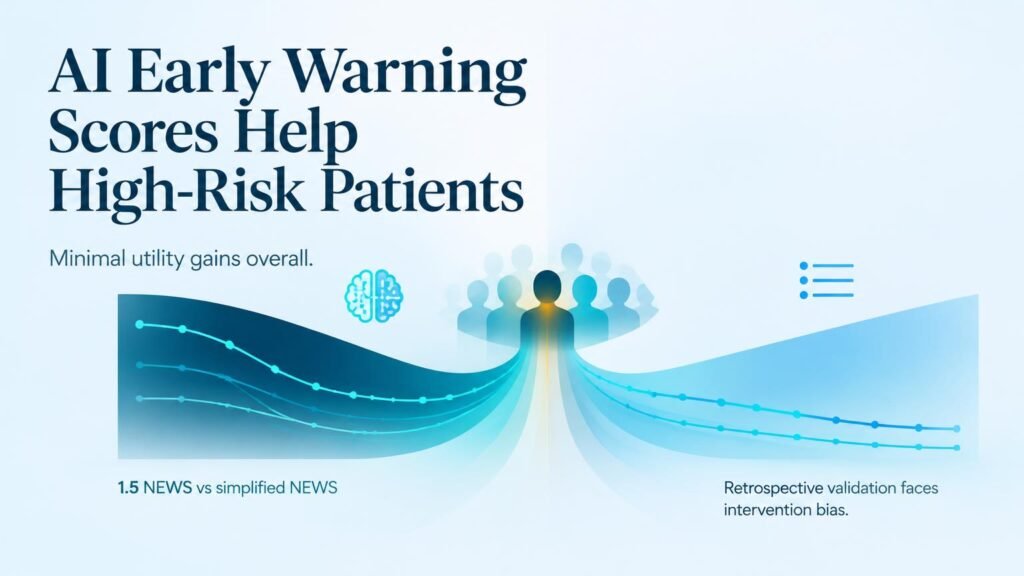
Deploying complex machine learning models across entire hospital populations yields negligible benefits over standard clinical scores unless monitoring targets high-risk patients.
Hospitals routinely deploy advanced algorithm suites to predict patient death within 24 hours. Yet across general ward populations, complex machine learning delivers almost no measurable clinical advantage over decades-old bedside scoring tools.
That realization redefines how health systems should deploy predictive algorithms. Rather than replacing simple vital-sign checks wholesale, health systems should reserve complex software for patients who are already clinically unstable.
A multicenter retrospective study analyzed 2,080,765 hospital encounters representing 825,200 unique patients across 15 Danish hospitals from 2018 to 2023. The cohort was 50.4% female, with 50.9% aged 18 to 65 years and 66.2% admitted to internal and acute medicine specialties. Researchers compared the standard National Early Warning Score (NEWS) against simplified scoring rules and a complex XGBoost model (XGB-EWS) incorporating vital signs, lab values, and medical history embeddings.
Marginal Gains Across Whole Populations
Across the entire hospital cohort, advanced modeling provided almost no population-level benefit over standard vital signs. Applying propensity score weighting to account for intercurrent treatment bias revealed that the real-world value of machine learning depends entirely on baseline patient risk.
- Overall cohort: XGB-EWS added a maximum of 1.9 correct mortality identifications per 10,000 patients over traditional NEWS.
- Low-risk group (NEWS 0–4): XGB-EWS yielded just 0.9 additional correct identifications per 10,000 patients over NEWS, while stripping blood pressure and temperature from NEWS reduced performance by only 0.1 per 10,000.
- High-risk group (NEWS ≥7): XGB-EWS delivered 78.1 additional correct identifications per 10,000 patients over standard NEWS, while simplified scoring caused a severe loss of 60.2 identifications per 10,000.
The operational signal is clear.
For low-risk ward patients, simplified scoring rules perform almost identically to complex algorithmic suites. Complex EHR-integrated models only justify their compute costs and alert burden when applied to high-risk cohorts.
Rethinking Clinical Risk Stratification
This finding challenges the widespread practice of running heavy predictive models across every admitted bed. As detailed in work on Course Corrections for Clinical AI, evaluating model performance strictly through overall discrimination metrics masks critical subgroup disparities that dictate real-world clinical utility.
A tiered monitoring strategy offers a practical alternative. Hospitals can use rapid, simplified scoring to reduce nursing documentation burdens on low-risk wards while reserving advanced algorithms for high-risk patients.
This analysis relies on retrospective electronic health records, meaning observational data cannot fully account for undocumented bedside decisions. Prospective randomized trials remain necessary to confirm whether risk-stratified digital monitoring directly improves survival.
Read the full research in The Lancet Digital Health.