 Yusuf Yesil, MD, MIS
Clinical artificial intelligence is facing an immediate operational reckon. Across hospital networks and outpatient care models, real-world AI deployments are generating structural friction, unaccounted oversight overhead, and systemic error modes that actively undermine initial efficiency targets. As regulatory and legal frameworks rapidly push liability onto health systems, healthcare leaders are realizing that software accuracy in validation trials rarely translates into net operational value at the point of care.
Where the signal came from
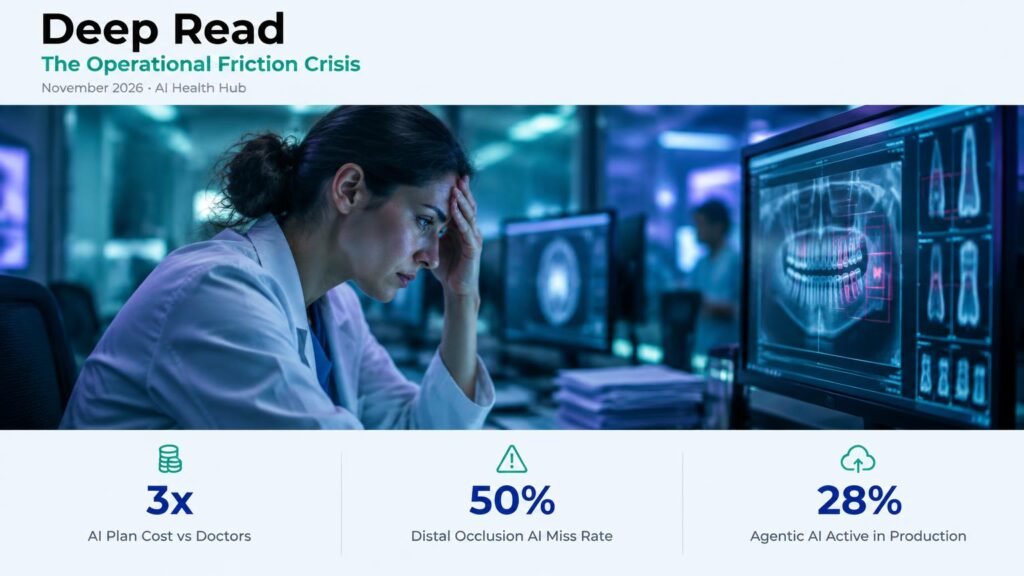
The evidence of this shift has moved from anecdotal friction to measurable empirical data across the past 30 days. In medical decision-support evaluation, a landmark study published in NEJM AI evaluating 24 general-purpose and specialized AI systems against 200 deidentified clinical encounters demonstrated that language models consistently order defensive over-testing, recommending clinical plans that cost more than triple what human physicians order ($314 per visit average). Far from reducing systemic expenditure, general decision-support models introduce automated cost expansion into routine outpatient and emergency care.
Simultaneously, diagnostic safety nets are showing severe domain failures under real-world clinical conditions. Research evaluating deployed stroke triaging algorithms revealed that while algorithms perform reliably on main arterial trunks, AI stroke tools miss half of distal occlusions, creating a perilous false-reassurance pattern for emergency intake teams. Furthermore, diagnostic algorithms continue to exploit artifactual shortcuts: recent research demonstrated that deep learning architectures trained on photoacoustic imaging achieve high validation metrics by exploiting hardware signatures to fake accuracy rather than detecting actual tissue pathology, guaranteeing silent failure upon multi-site hardware transfer.
Even in administrative workflow automation—long touted as the low-hanging fruit of health tech—operational efficiency gains are collapsing under human-in-the-loop inspection burdens. A comprehensive enterprise trial examining generative inbox draft assistants found that deploying AI portal replies does not save time across hospital networks unless clinicians radically alter daily review habits; uncalibrated rollouts actually increased total communication latency. Meanwhile, randomized trials evaluating maternal mental health support demonstrated that AI chatbots fail to lower maternal mental distress over a full year compared to standard materials, demonstrating that conversational availability does not equal clinical efficacy.
This operational disconnect arrives precisely as governance and regulatory dynamics shift liability directly onto provider organizations. The Department of Health and Human Services finalized the HTI-5 rule, cutting mandatory model card disclosures to save developers $1.55 billion, effectively declaring that HHS deregulatory rules shift evaluation risk to hospitals. Simultaneously, the American Medical Association updated its legal guidance, explicitly establishing that physician sign-off no longer shields health systems from liability if underlying software design is flawed, exposing severe EHR logging deficits when clinical AI causes harm. Despite these structural headwinds, vendor deployment continues unabated: a survey of 250 healthcare leaders showed 28% have agentic AI in production while platforms like Zocdoc aggressively open underlying booking infrastructure, revealing that Zocdoc opens scheduling access to autonomous AI agents while enterprise systems scramble for control tools.
What’s actually shifting
The core assumption of the 2023–2025 health AI expansion was that model performance would cleanly scale into operational clinical value. That assumption is now broken. The industry is confronting the first-principles reality of healthcare operations: clinical workflows are non-linear, risk-averse systems where the cost of verification often exceeds the cost of primary execution. When an algorithm generates a draft summary, a diagnostic suggestion, or an automated prior authorization, human clinicians must audit that output. If the audit requires evaluating defensive over-testing suggestions or double-checking subtle distal vascular blockages, the cognitive load on the clinician increases rather than decreases.
What has changed structurally is the transition from point-solution diagnostic validation to systemic workflow integration. In static pilot environments, algorithms are evaluated on benchmark datasets (such as ROC-AUC curves or F1 scores). In live environments, algorithms interact with human behavior, institutional liability, and reimbursement incentives. The NEJM AI findings on cost tripling expose defensive prompt framing and foundational pre-training biases: models optimize for zero-omission risk, recommending every possible diagnostic workup to eliminate theoretical liability, whereas practicing physicians operate under pragmatic probabilistic decision-making and resource constraints.
Furthermore, the physical reality of clinical care is exposing the brittleness of black-box models across heterogeneous hospital hardware. As demonstrated in photoacoustic imaging studies, neural networks routinely memorize imaging system artifacts, scanner noise signatures, and institutional metadata rather than true biological pathology. When deployed outside the originating academic medical center, these models suffer immediate generalization decay. Yet, under the newly finalized HTI-5 rule, developers are no longer required to publish detailed transparency metrics or model cards for predictive algorithms, transferring the complex burden of multi-site post-market surveillance onto hospital IT departments.
The legal framework has caught up with this operational reality. Historically, health systems relied on the ‘learned intermediary’ doctrine and physician sign-off as a legal firewall. If a doctor signed an AI-generated discharge summary or approved an AI-triaged scan, legal accountability rested on the clinician. The AMA’s revised policy framework dismantles this assumption. By establishing that human oversight cannot offset inadequate algorithmic engineering or lack of clinical trial evidence, the AMA has shifted direct legal exposure to the health system’s software procurement and EHR audit infrastructure. When doctors routinely miss subtle drafting errors in fast-paced emergency settings—as proven in recent pediatric emergency discharge trials—the safety net of human sign-off is exposed as a dangerous legal fiction.
Finally, we are witnessing a sharp divergence between enterprise IT control and consumer-facing agentic software. While health system CIOs build oversight committees to mitigate autonomous risk, consumer platforms and scheduling aggregators are bypassing enterprise firewalls entirely. Zocdoc’s deliberate move to open API scheduling access to third-party autonomous bots (such as Google Gemini and Instinct) demonstrates that consumer demand for autonomous transaction execution is outpacing institutional governance frameworks. Health systems are caught in a vise between ungoverned agentic traffic at the front door and brittle, liability-heavy diagnostic models in the back office.
What it means for builders
For clinical AI builders and health tech founders, the era of selling wrapper LLMs and generic decision-support tools anchored on diagnostic accuracy benchmarks is over. Capital and clinical buyers are shifting toward software engineered around verifiable cognitive friction and automated audit trails. Founders must pivot away from open-ended generative recommendations that trigger defensive over-testing. If your platform suggests clinical workups, it must be explicitly calibrated against regional care pathways, cost efficiency parameters, and localized reimbursement realities rather than unconstrained defensive medicine.
Builders must stop pitching ‘human-in-the-loop’ as a magic bullet for liability and accuracy. If your product relies on a busy clinician reviewing complex output in under 10 seconds, your system will fail in production, either by driving cognitive burnout or by letting catastrophic errors slip into permanent records. Instead, build zero-click narrow post-processing tools that solve explicit mechanical bottlenecks—such as FDA-cleared zero-click CTA post-processing tools that automatically strip bone and soft tissue without requiring staff intervention, or narrow triage tools that streamline ER workflow logistics without attempting full diagnostic substitution.
What NOT to build: Do not build broad, general-purpose clinical advice tools or standalone mental health conversational bots aimed at minoritized or high-risk populations without human intervention channels. The empirical failure of chatbot trials to alter maternal distress or lower adolescent crisis rates proves that conversational UI cannot replace structured clinical care delivery. Furthermore, avoid building predictive tools that require complex, obscure lab inputs; research shows compact models using interpretability-driven feature selection achieve equal predictive power with four-fifths fewer clinical data inputs, reducing workflow integration friction.
What it means for health systems
Hospital CIOs, Chief Medical Officers, and digital health procurement leads must immediately audit their AI portfolio for hidden verification costs and liability exposure. In light of the HTI-5 rule changes, health systems can no longer rely on vendor model disclosures. Health systems must institute internal algorithmic auditing protocols, evaluating live post-deployment error rates, site-specific calibration decay, and defensive over-testing patterns before expanding pilot software enterprise-wide.
Procurement teams must demand deep EHR audit-logging capabilities from vendors to survive the new AMA liability standards. If a deployed algorithm generates clinical notes, prior authorization submissions, or triage flags, the health system’s EHR logging must capture the exact prompt history, model version, confidence calibration, and clinician interaction timeline. Without granular log records, hospitals face unmitigated legal exposure when automated decisions lead to care denials, delayed emergency interventions, or diagnostic misses.
The contrarian read
The contrarian perspective argues that the current operational friction is merely a temporary artifact of early-stage integration, and that holding AI systems to zero-error standards ignores the massive baseline inefficiency of human clinical medicine. Proponents of rapid autonomous deployment point out that emergency department delays, manual prior authorization backlogs, and missed incidental findings on CT scans are already rampant across human-only workflows. They argue that restricting agentic deployment due to defensive over-testing or occasional distal occlusion misses will stall long-term gains in health system throughput, unnecessarily capping total care capacity in the face of worsening clinical workforce shortages.
Bottom line
Clinical AI value is no longer measured by validation accuracy on benchmark datasets, but by net operational efficiency and verifiable risk reduction inside live clinical workflows.