
Radiologists often spend critical minutes manually isolating blood vessels from bone in head and neck imaging during acute stroke evaluations.
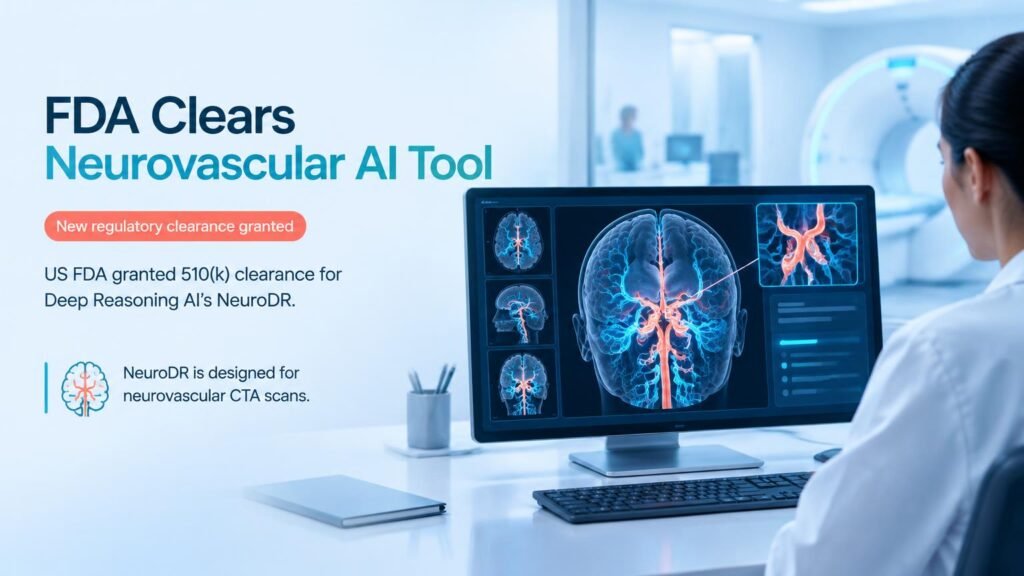
The US Food and Drug Administration has cleared NeuroDR, a zero-click artificial intelligence tool designed to automatically post-process neurovascular computed tomography angiography (CTA) scans. Developed by Deep Reasoning AI alongside 3DR Labs and Innolitics, the software removes bone, soft tissue, and veins from CTA scans without requiring manual input from staff.
Bypassing Manual Post-Processing
Instead of relying on technologist time to slice away anatomical background noise, the system generates 3D reconstructions and segmented views of anterior and posterior blood flow. It sends these files straight to hospital picture archiving and communication systems (PACS). This shifts AI’s role from basic triage alerts to performing complex visual prep work for emergency clinicians.
Clinical Limits and Readiness
Clearing a 510(k) pathway indicates substantial equivalence to existing post-processing tools, but it does not equal evidence of improved patient survival or faster treatment times. The system functions as an adjunctive aid, meaning human radiologists remain fully responsible for final diagnostic interpretations and identifying subtle vascular abnormalities.
Hospitals evaluating the technology must verify whether automated bone subtraction maintains accuracy in complex cases with severe calcification or metal artifacts, where automated algorithms historically struggle.