
Deploying AI inbox drafts across a hospital network can actually slow down communication unless clinicians actively engage with the technology.
Hospitals introduced generative draft tools to tackle physician burnout and crushing inbox volumes. A massive enterprise study reveals that rolling out the feature does not automatically save time. In fact, simply making the system available led to longer delays overall.
That disconnect highlights the operational gap between software deployment and real clinical efficiency. Earlier evaluations of AI-generated inbox drafts showed clear technical potential, but hospital workflows introduce subtle friction. When software creates extra supervisory steps without replacing existing habits, baseline workload grows.
What the Data Shows
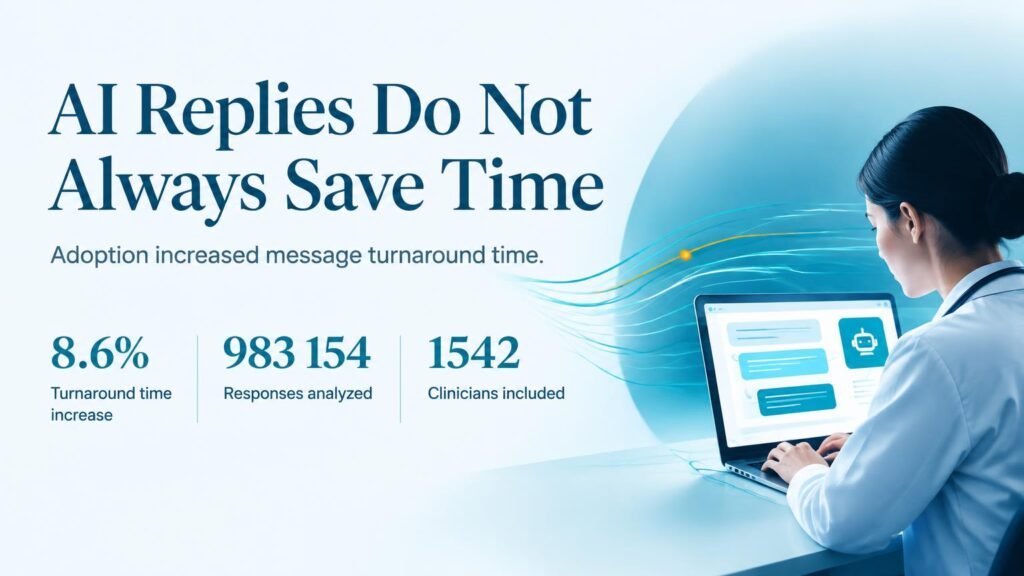
Researchers analyzed 983,154 first responses sent by 1,542 clinicians to 272,091 patients at Columbia University Irving Medical Center between March 2023 and May 2025. Following enterprise deployment of Epic’s automated draft tool in December 2024, general feature adoption was associated with an 8.6% increase in overall message turnaround time. Yet when clinicians actually used the tool to craft a reply, turnaround time dropped by 29.5%.
- Enterprise adoption correlated with an 8.6% increase in overall turnaround time.
- Active tool usage reduced individual turnaround time by 29.5%.
- The tool caused no overall reduction in after-hours work burden, showing a non-significant 0.61 percentage point change.
- For daytime test result queries, draft usage reduced after-hours replies by 3.67 percentage points.
- For off-hours patient messages, draft usage increased after-hours clinician replies by 4.52 percentage points.
The After-Hours Spillover
The system did not eliminate off-hours labor. Instead, it altered when clinicians logged on to clear their queues.
For routine lab queries arriving during clinic hours, draft responses helped clinicians close tickets faster and leave on time. But when patient messages arrived late, ready-made drafts made it easier for doctors to quickly reply from home. By making messaging easier, the tool lowered the barrier to working during personal time.
Limits and Reality
These single-site observational findings carry clear limits. The after-hours results proved sensitive to how working hours were defined in secondary analyses. Crucially, faster reply speeds do not measure message accuracy, patient safety, or clinician burnout.
Health systems cannot treat draft tools as passive productivity fixes. Without firm guardrails around after-hours communication, automation risks expanding the workday rather than shortening it.
Read the full study in JAMA Network Open.