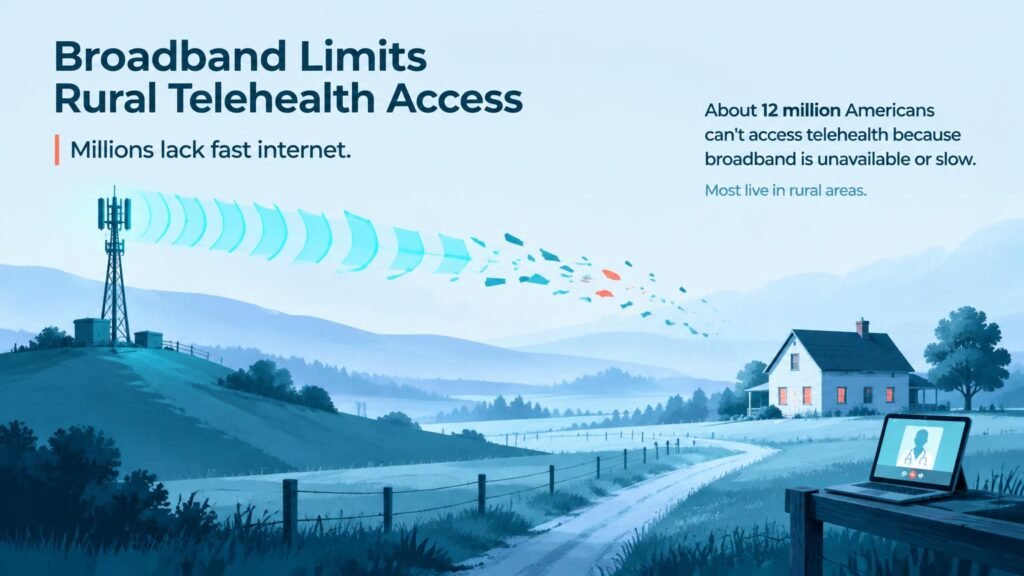
Nearly 12 million Americans remain entirely cut off from virtual care due to inadequate internet infrastructure.
Digital health initiatives assume patients have high-speed internet. 11.9 million Americans live in broadband deserts with connection speeds under 100/20 Mbps. Rural communities bear the brunt, accounting for 88% of those affected across the West and South.
The Triple Burden
Infrastructure deficits directly undermine rural health access. Approximately 649,000 rural residents face a severe compounding crisis. They lack high-speed internet, local clinical care, and emergency services simultaneously.
For these populations, telehealth is not a convenient alternative. It is often the only viable entry point into the health system. Expanding virtual care billing codes accomplishes little when patients cannot load a video stream.
Beyond Physical Cabling
Signal availability is only part of the problem. High subscription costs, low digital literacy, and a lack of modern devices create additional barriers. Federal expansion funds risk misallocating resources if they focus solely on software adoption rather than foundational connectivity.
Health systems evaluating remote care models must recognize that digital strategies currently exclude the most vulnerable patient populations. Without physical infrastructure investments, virtual care widens existing health disparities instead of closing them.