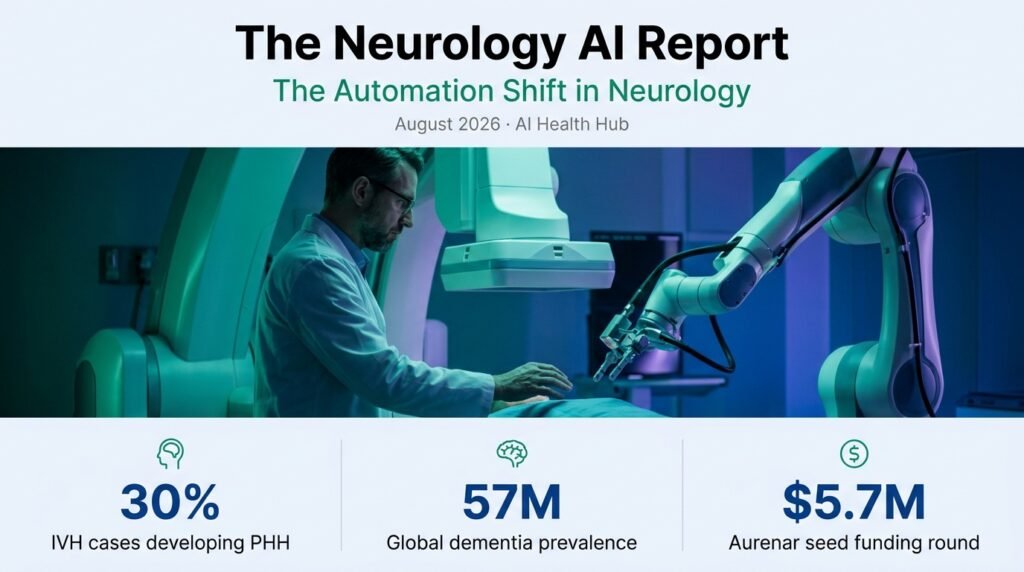
The field of neurology is undergoing a structural transition. For years, artificial intelligence in this specialty was confined to retrospective image analysis and diagnostic assistance. This month’s developments signal a shift toward active automation, localized edge computing, and closed-loop neuromodulation. Clinicians and product teams are moving past simple classification models to embrace systems that directly guide or execute therapeutic interventions, from automated mechanical thrombectomies to real-time surgical mapping.
This transition is driven by the clinical reality of acute neurological care, where minutes dictate tissue survival. By deploying models directly at the point of care—whether through local language models processing emergency room triage notes or automated vacuum systems operating inside cerebral vessels—the industry is beginning to address the latency and data-sharing bottlenecks that have historically limited the real-world utility of digital health tools.
Notable papers
• Towards neuromorphic neurotechnologies: integrating brain-inspired computing with brain-computer interfaces (npj Biomedical Innovations)
This review details how brain-inspired neuromorphic computing architectures can decode complex neural recordings in real time to restore motor and sensory functions.
Brand take: Genuinely useful clinically, as traditional computing architectures lack the power efficiency required for fully implantable, closed-loop brain-computer interfaces.
• AI-aided neuroimaging for the diagnosis of Alzheimer’s disease: A concise review of recent studies (Heliyon)
This review synthesizes how machine learning models leverage structural MRI and PET scans to identify early-stage amyloid deposition and regional brain atrophy.
Brand take: Overhyped, as the clinical bottleneck is no longer image classification but rather the high cost and limited accessibility of PET imaging itself.
• Artificial Intelligence for Early Detection of Alzheimer’s Disease: A Comparative Review of Speech, Neuroimaging, and EEG Biomarkers (American Journal for Young Scientists)
The paper compares diagnostic modalities, highlighting that multi-modal AI combining speech analysis and EEG achieves superior sensitivity over single-channel diagnostic tools.
Brand take: Underrated, because non-invasive, low-cost acoustic biomarkers represent a highly scalable triage mechanism prior to expensive neuroimaging.
• Dissecting multimodal predictors of psychosis risk and remission in youth at ultra‑high risk of developing psychosis: An exploratory study (PLOS mental health)
This study demonstrates that integrating neuroimaging data with clinical CAARMS assessments using machine learning improves the precision of psychosis risk stratification in youth.
Brand take: Genuinely useful clinically, as current clinical-only assessments suffer from high false-positive rates that complicate early intervention strategies.
• T-cell infiltration is associated with increased reactive astrocytosis and tumor necrosis factor alpha in intraventricular hemorrhage (Scientific Reports)
This study establishes that neuroinflammation and T-cell infiltration drive post-hemorrhagic hydrocephalus, which develops in up to 30% of intraventricular hemorrhage cases.
Brand take: Genuinely useful clinically, as identifying these specific inflammatory pathways provides clear biological targets for future predictive AI models in neonatal intensive care.
Products, deals & funding
• Aurenar V-Link Seed Funding
Aurenar closed an oversubscribed $5.7 million seed round to advance its V-Link device, a non-invasive transcutaneous auricular vagus nerve stimulation system designed to treat inflammation in the ICU [Source].
Brand take: Genuinely useful clinically, as non-invasive neuromodulation offers a low-risk alternative to systemic anti-inflammatory drugs in critically ill patients.
• Humanity Neurotech Seed Round
Humanity Neurotech raised a $2 million seed funding round to accelerate the development of its novel device therapies targeting brain disorders [Source].
Brand take: Underrated, as early-stage hardware-software integration in neurology remains starved for capital compared to pure-play software solutions.
• CN Suite for Epilepsy Surgery
A multicenter validation study of the CN Suite computational platform demonstrated its ability to pinpoint compact brain targets to help neurosurgeons halt drug-resistant seizures (Yesil Science).
Brand take: Genuinely useful clinically, as it moves epilepsy surgery away from qualitative visual analysis of EEG tracings toward quantitative, objective localization.
• Local Language Models for Stroke Triage
A clinical trial validated a mid-sized local language model that flags stroke patients directly from emergency department triage notes without requiring cloud-based data transfer (Yesil Science).
Brand take: Genuinely useful clinically, as local deployment resolves the data privacy and latency issues that prevent cloud-based triage tools from being adopted in emergency medicine.
Regulatory & clinical adoption
• FDA Clearance of Penumbra Thunderbolt Catheter System
The FDA cleared Penumbra’s Thunderbolt system, the first computer-assisted vacuum thrombectomy device designed to automate clot removal in acute ischemic stroke patients (Yesil Science).
Brand take: Genuinely useful clinically, as algorithmic modulation of vacuum pressure reduces the risk of vessel wall damage compared to manual suction.
• Ceribell AI EEG Portal Clearance
Ceribell received FDA 510(k) clearance for two AI algorithms, Epileptiform Abnormality Detection and Artifact Reduction, integrated into its cloud-based Neurology Portal to support rapid EEG assessment in emergency and ICU settings [Source].
Brand take: Genuinely useful clinically, as it allows non-specialist bedside clinicians to confidently identify non-convulsive status epilepticus without waiting hours for a formal neurology consult.
• FDA Generative AI Discussion Paper
The FDA published a discussion paper seeking public feedback on regulating generative AI-enabled medical devices, highlighting that zero generative AI tools have been clinically authorized to date [Source].
Brand take: Overhyped, as the regulatory framework for generative models is still years away from supporting safe, autonomous clinical decision-making.
Trends & what to watch
The clinical validation gap remains the most significant hurdle for neurology AI. A comprehensive study published in PLOS Digital Health revealed that out of more than 1,300 FDA-authorized AI medical devices, only three had undergone rigorous evaluation for patient-centered outcomes [Source]. This lack of prospective, outcome-driven data is stalling deep clinical integration. Over the next 1-3 months, expect payers and hospital systems to demand more than simple diagnostic accuracy metrics; developers must prove their algorithms reduce ICU length of stay, lower readmission rates, or improve functional independence scores.
Simultaneously, we are seeing a shift away from signal averaging in neurophysiology. Traditional methods that smooth out electrical fluctuations to clean up data are being replaced by deep learning models capable of analyzing raw, single-pulse dynamics. As demonstrated by recent epilepsy research (Yesil Science), preserving these micro-fluctuations allows for far more precise localization of pathology. Product teams should focus on building models that ingest high-frequency, raw physiological streams rather than pre-processed, simplified datasets.
Bottom line
The future of neurology AI belongs to edge-deployed, closed-loop systems that translate raw physiological signals directly into automated therapeutic actions.