The practice of anesthesiology is undergoing a structural transition. Long confined to passive physiological monitoring, artificial intelligence is moving into active intraoperative guidance, clinical decision support, and structured reimbursement. This shift is redefining the specialty beyond the traditional boundaries of the operating room, positioning anesthesiologists as perioperative and critical care coordinators who manage complex, data-rich environments.
However, this rapid technological expansion faces a stark clinical reality. While state-level regulations and novel billing codes are establishing a formal framework for AI adoption, researchers are flagging a severe deficit in prospective clinical trials. To maintain clinical safety and institutional trust, the next phase of anesthesiology AI must bridge the gap between retrospective performance and prospective validation.
Notable papers
• Field grand challenge: beyond putting patients asleep: redefining the mission of anesthesiology
This paper outlines the evolution of anesthesiology from simple drug administration to a comprehensive medical specialty dedicated to preserving homeostasis and managing perioperative pathways.
Brand take: Genuinely useful clinically, as it establishes the conceptual framework needed to integrate AI across the entire perioperative continuum rather than just the intraoperative phase.
• Performance evaluation of ARIMA, VAR, ANN, GRU, and LSTM for multivariate healthcare time-series prediction: a rigorous, reproducible benchmarking study with ablation analysis on MIMIC-III and eICU
This benchmarking study evaluated multiple machine learning models on ICU datasets, demonstrating that advanced recurrent architectures (GRU and LSTM) outperform classical models in predicting physiological deterioration.
Brand take: Underrated, because rigorous benchmarking against classical baselines is exactly what is needed to prevent clinical teams from deploying overly complex, unvalidated models.
• Readiness for remote healthcare and artificial intelligence in kidney transplant care: a cross-sectional study
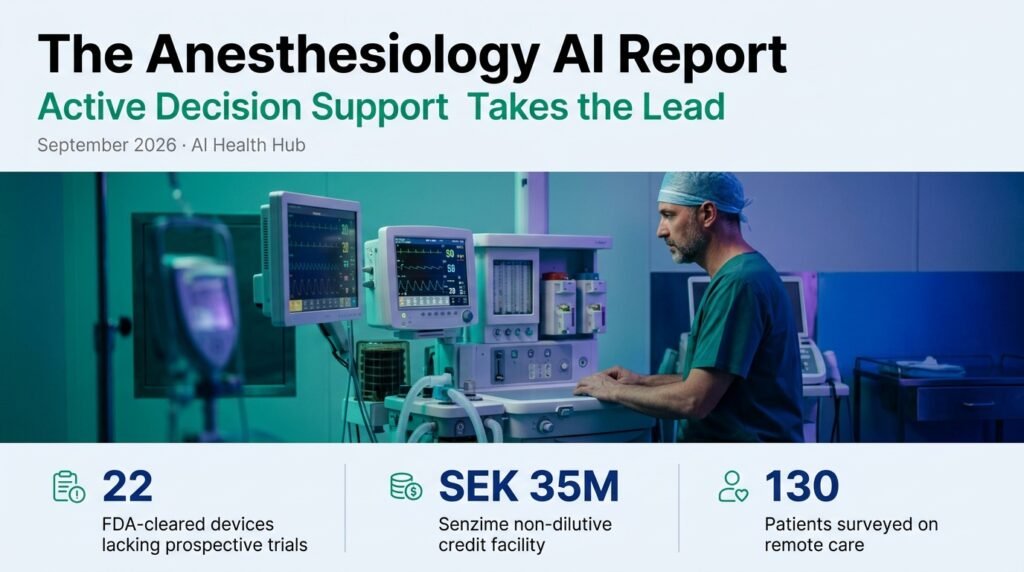
A survey of 130 post-transplant patients revealed high baseline willingness to adopt AI-driven remote monitoring, provided that human clinical oversight remains directly accessible.
Brand take: Genuinely useful clinically, as it highlights that patient trust in perioperative AI is contingent on maintaining clear lines of clinician communication.
• Electrical impedance tomography beyond the icu: wearable architectures and AI under translational constraints
This review details how wearable EIT architectures combined with AI are transitioning from ICU lung monitoring to broader point-of-care applications.
Brand take: Overhyped, as hardware limitations and motion artifacts still present massive translational barriers for active intraoperative use.
• AI-enabled digital therapeutics in pharmacy practice: prescription software, medication optimization, safety surveillance, and future clinical positioning
This paper explores how AI-driven software optimizes medication dosing and active safety surveillance, directly impacting perioperative pharmacology.
Brand take: Genuinely useful clinically, as automated medication safety surveillance directly addresses the high-stress, high-error-risk environment of the operating room.
Products, deals & funding
• Senzime Credit Facility
Swedish medical technology company Senzime secured a SEK 35 million non-dilutive credit facility to accelerate the commercial expansion of its precise neuromuscular monitoring systems, which utilize algorithmic dosing to secure the administration of paralytic drugs.
Brand take: Genuinely useful clinically, as objective neuromuscular monitoring is critical to preventing postoperative residual curarization.
• Yale’s Anesthesia Playground
Researchers at the Yale School of Medicine launched ‘Anesthesia Playground,’ an interactive, AI-enabled simulation platform designed to personalize training and demystify complex operating room scenarios for medical students.
Brand take: Underrated, as interactive, low-stakes simulation environments are highly effective for accelerating the early clinical learning curve.
• Dual AI Sepsis Predictors
As detailed in our previous coverage of dual AI models for sepsis and predictive sepsis tools, dual-model decision support systems are successfully flagging patient deterioration hours before clinical onset, translating directly into reduced ICU stays and lower hospital costs.
Brand take: Genuinely useful clinically, as linking early algorithmic detection with clear financial and clinical outcomes is the only way to justify enterprise software procurement.
Regulatory & clinical adoption
• RIVANNA CMS Code Approval
The Centers for Medicare & Medicaid Services approved a new ICD-10-PCS procedure code for RIVANNA’s real-time AI-enabled ultrasound navigation with continuous needle tracking, establishing the first dedicated national inpatient coding category for neuraxial anesthesia.
Brand take: Genuinely useful clinically, as formal reimbursement pathways are the single most powerful driver for widespread clinical adoption of AI-guided procedures.
• The FDA Clinical Evidence Gap
A study published in PLOS Digital Health analyzed FDA-cleared anesthesiology AI devices and revealed a major regulatory blind spot: none of the 22 cleared devices on the market had registered prospective clinical trials.
Brand take: Overhyped regulatory process, as clearing devices based solely on retrospective data creates a false sense of security and leaves clinicians to discover real-world failures at the bedside.
• State-Level AI Governance
As federal regulations stall, states are stepping in. Connecticut’s CART Act, highlighted in our analysis of state-level AI playbooks, establishes strict compliance rules for high-risk clinical AI applications, forcing developers to navigate a patchwork of local laws.
Brand take: Underrated, because state-level compliance will dictate the operational footprint of clinical AI long before federal agencies reach a consensus.
Trends & what to watch
The next 1-3 months will likely see a push toward multimodal data integration in the perioperative suite. Rather than relying on isolated alarms, developers are focusing on models that can synthesize disparate data streams. However, as shown in our evaluation of adaptive LLM swarms, letting models recursively debate clinical risks can lead to increased pessimism and bias rather than improved accuracy. Clinicians must remain cautious of ‘consensus’ models that lack objective ground truths.
Simultaneously, the trend of simplifying complex EHR data is gaining traction. Innovative approaches that flatten medical records into visual maps are helping clinicians digest massive amounts of ICU data quickly. This visual simplification, combined with new reimbursement codes like those granted to RIVANNA, will accelerate the transition of AI from an experimental tool to a standard clinical billing component.
Bottom line
Anesthesiology AI is successfully securing reimbursement and commercial funding, but its clinical credibility depends on replacing retrospective validation with rigorous, prospective clinical trials.