
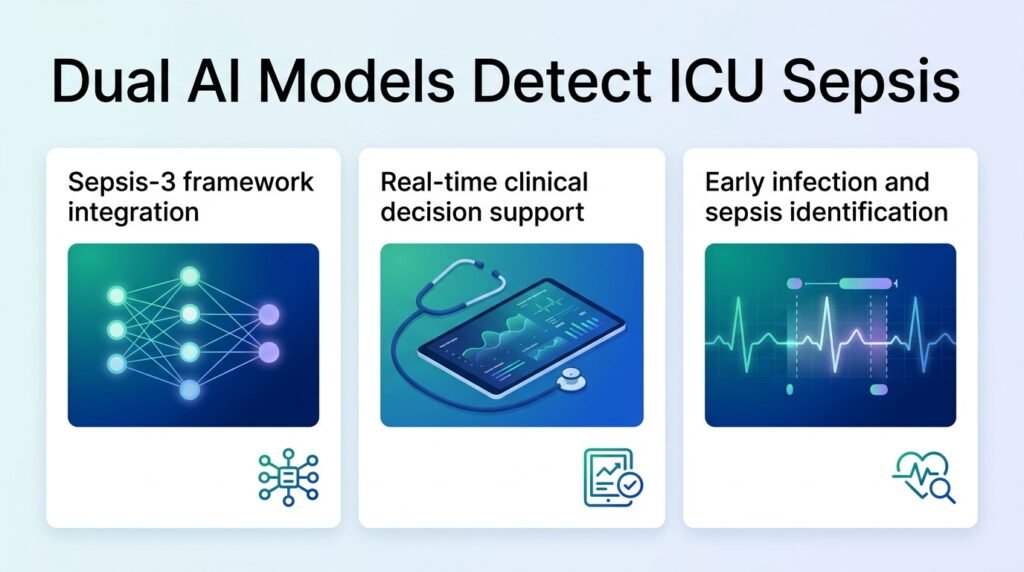
A new dual-model AI system catches sepsis and infection hours before they turn fatal, shifting the ICU from reactive treatment to proactive defense.
Why do we keep losing patients to sepsis when we have powerful antibiotics? The answer is timing. Sepsis and infection overlap in confusing ways, and waiting for lab cultures to confirm a diagnosis often takes days. By then, organ failure has already set in.
This is where a new dual-model clinical decision support system steps in. Instead of treating infection and sepsis as a single problem, the system splits them. It challenges the traditional approach of waiting for a single, definitive clinical signal.
Splitting infection from sepsis
The researchers trained two distinct machine learning models using adult ICU data from 2018 to 2020 at a tertiary-care medical center. One model targets infection, defined by positive microbiological cultures. The other predicts sepsis, defined by the strict Sepsis-3 framework. This dual-track design aligns with the Surviving Sepsis Campaign guidelines, which emphasize rapid, targeted intervention.
The system analyzes structured clinical features over an 8-hour window. It operates with an 8-hour lead time and a 1-hour prediction window, giving clinicians a crucial head start. To keep the data clean, the team used propensity score matching and Borderline SMOTE to handle class imbalances. They also validated the tool externally using the MIMIC-IV database.
The performance metrics
The system proved remarkably stable under pressure. It maintained high diagnostic accuracy across multiple testing environments. The key results highlight this stability:
- The models achieved area under the receiver operating characteristic curves ranging from 0.75 to 0.85.
- This performance held steady across internal, reduced-feature, and external validation cohorts.
- The system prioritized high sensitivity and negative predictive value to minimize missed cases.
During real-time ICU deployment, a bedside dashboard displayed these risk estimates directly to clinicians. This builds on previous research, such as earlier AI algorithms for ICU sepsis diagnosis, by proving that predictive models can survive the transition from retrospective databases to live, chaotic hospital wards.
The clinical reality check
But we must look closely at the actual clinical impact. While the prospective deployment showed numerically lower point estimates for hospital resource use and clinical outcomes, these figures were not adjusted for confounding factors. We do not yet have randomized trial proof that this AI saves lives. That is a vital limitation that eager health systems must keep in mind.
The real value here is risk stratification. The system successfully clustered patients into high-risk subgroups that consumed the most resources. This allows hospitals to allocate scarce ICU staff where they are needed most. It is a highly sensitive radar system that gives clinicians an 8-hour window to change a patient’s trajectory before the damage is done.
Read the full study in BMJ Quality & Safety.