 Yusuf Yesil, MD, MIS
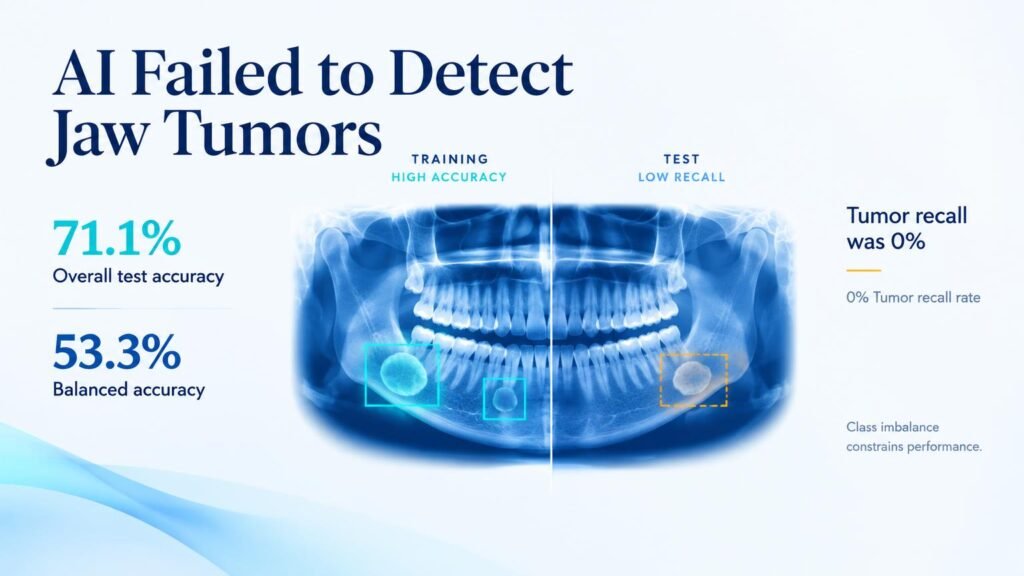
Differential diagnosis for jaw lesions traditionally relies on invasive, expensive histopathology. While earlier research built algorithms for segmentation of periapical lesions on panoramic radiographs, scaling to multi-class triage presents a much steeper hurdle. This trial exposes the dangerous blind spots that emerge when clinical AI runs into extreme class imbalance.
High Accuracy Masked Failure
Researchers built a two-task architecture using an EfficientNet-B3 classifier alongside a YOLOv8-Seg localization model. They verified all panoramic radiographs against histopathology reports and trained the setup on a multi-center dataset. On the training set, the classification algorithm posted an impressive 96.40% accuracy.
Once deployed on a held-out test set of 90 cases, that performance collapsed. Overall accuracy dropped to 71.1%, while balanced accuracy fell to just 53.3%.
The system managed common conditions reasonably well, achieving 87.5% recall for abscesses and 72.5% recall for cysts. But for rare jaw tumors, the classifier recorded 0% recall across the entire test cohort. Relying on this model in a clinic would mean missing every critical malignancy.
That failure rate shows how misleading aggregate metrics can be in medical imaging.
Model Disagreement and Data Bottlenecks
The segmentation architecture struggled as well. YOLOv8-Seg localized lesions at 65.0% for abscesses, 37.5% for cysts, and 60.0% for tumors. However, its diagnostic typing sensitivity reached only 50.0%, 32.5%, and 30.0% across those respective groups.
- Classifier accuracy: Fell from 96.40% in training to 71.1% on test data.
- Abscess recall: Led the performance metrics at 87.5%.
- Tumor recall: Dropped to 0% due to severe data scarcity.
- Segmentation sensitivity: Peaked at just 50.0% for abscess typing.
Similar challenges appear in past studies targeting detection of radiolucent jaw lesions using constrained cohorts. When two structurally different neural networks fail on the exact same disease category, the limitation rests with the dataset, not the code.
The Triage Dilemma
Retrospective results on a 90-case test set demonstrate that algorithm design cannot make up for skewed sample sizes. A tool meant to assist clinical triage becomes a liability if it consistently overlooks high-stakes diagnoses.
Before these frameworks earn a spot in dental workflows, developers must train them on larger, balanced, multi-institutional datasets that reflect true disease variance.
Read the original research in BMC Oral Health.