
Algorithms trace heart contours better than human eyes, but the actual survival advantage in clinic remains modest.
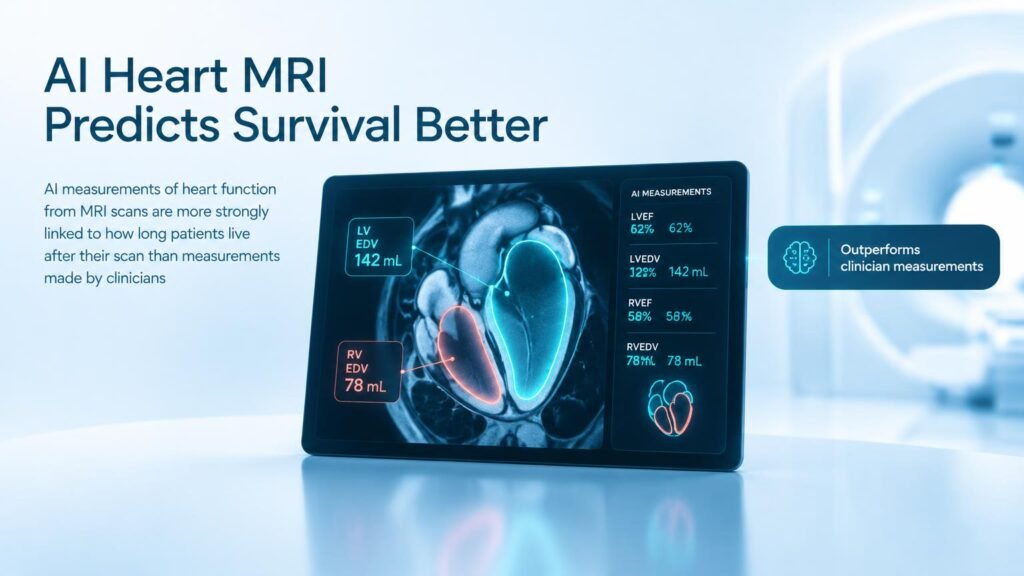
Cardiologists rely heavily on ejection fraction to decide which heart patients need aggressive treatment or implantable devices. A massive new study reveals that automated deep-learning models measure this vital metric with greater prognostic accuracy than trained physicians.
This finding challenges the long-held assumption that manual expert segmentation represents the ultimate gold standard for cardiac risk stratification.
Researchers evaluated 27,382 consecutive patients across nine UK hospitals linked to Barts Heart Centre and the University of Pittsburgh Medical Centre. The multi-center cohort included 26,106 London patients scanned between 2014 and 2019 alongside 1,276 US patients scanned from 2010 to 2016. Across a median follow-up of 5.6 years, 3,458 patients (13%) died.
Comparing AI and Expert Precision
When predicting all-cause mortality, AI-derived ejection fraction systematically outperformed clinician contours. The algorithm demonstrated tighter overall model fit with an Akaike Information Criterion of 57,936 versus 58,097 for clinicians, representing a 161-point statistical advantage.
Adding AI measurements to clinician data drastically improved prognostic performance, whereas adding human measurements to the AI model yielded minimal gain.
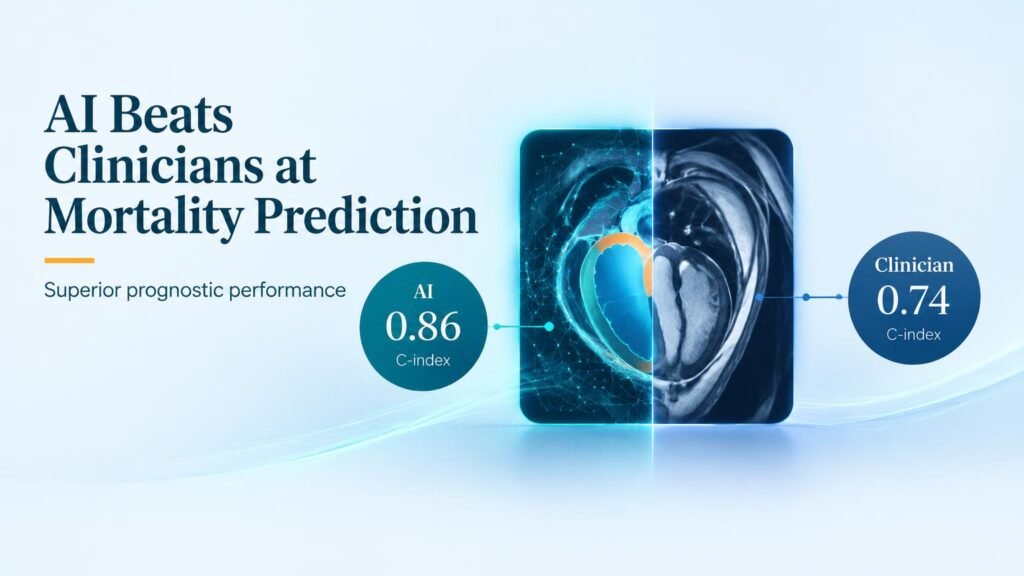
Without adjustments, the AI achieved a concordance index of 0.669 compared to 0.637 for clinicians, marking a 0.033 improvement. However, after adjusting for patient age and sex, that discrimination gap narrowed dramatically to a marginal 0.004 difference (C-index 0.781 vs 0.777). This mirrors prior work on cine magnetic resonance segmentation, where automated tracking matched clinical standards while offering superior speed.
Key Study Results
- Model fit preference: Unadjusted AI model yielded lower AIC (57,936 vs 58,097, ΔAIC 161).
- Incremental statistical value: AI added significant predictive power to clinician models (χ2=168, p<0.0001), while human oversight added minimal value to AI (χ2=7.5, p=0.023).
- Age-adjusted discrimination: Age and sex adjustment reduced the AI advantage from ΔC 0.033 to ΔC 0.004 (0.781 vs 0.777).
Operational Impact and Limitations
The statistical win is real, but clinicians should avoid overinterpreting the findings. A C-index gain of 0.004 after demographic adjustment means AI will rarely alter risk tiers for individual patients on its own.
Furthermore, retrospective imaging datasets cannot prove that swapping human segmentation for software improves downstream patient outcomes or reduces health system costs without prospective trial data.
Earlier research into four-chamber cardiac segmentation established automated efficiency, but clinical implementation requires proving workflow reliability. AI software works best as a rapid first-line reader under human oversight to standardize measurements across busy radiology departments.
Read the complete peer-reviewed study in The Lancet Digital Health.