Yusuf Yesil, MD, MIS
Solving Target Specificity in Molecular Diagnostics
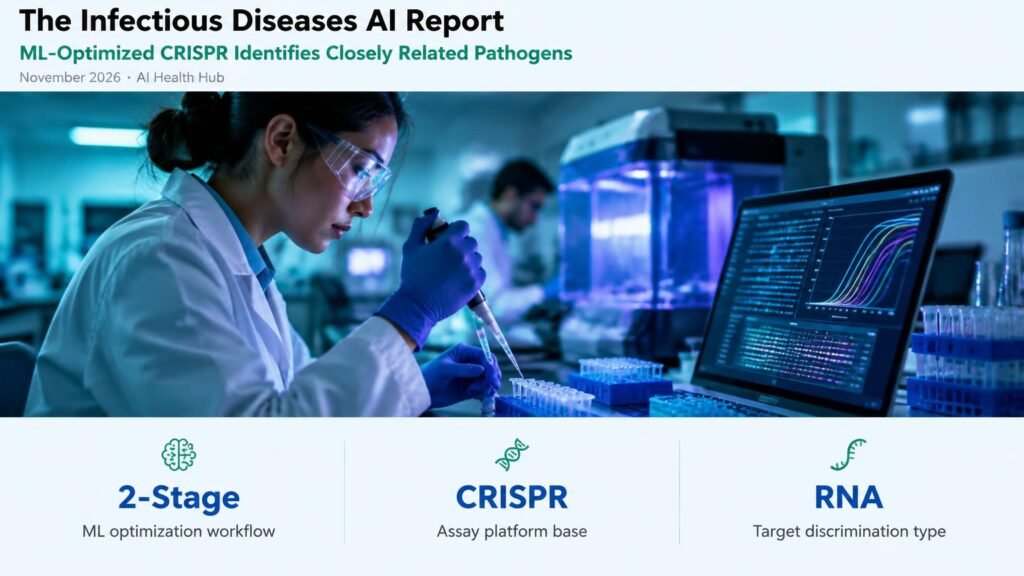
Conventional molecular diagnostic assays often suffer from a narrow target focus, which risks missing or delaying the recognition of outbreaks caused by closely related but non-identical pathogen variants. Recent research published in Scientific Reports demonstrates that integrating machine learning into CRISPR-based detection workflows allows rapid optimization of assays to discriminate ranges of closely related RNA targets (Scientific Reports, 2026).
Data-Driven Assay Design
By leveraging machine learning models to guide guide RNA (gRNA) design and reaction parameter selection, the two-stage framework systematically identifies sequence variations that distinguish closely related zoonotic and viral strains. This computational optimization overcomes the trial-and-error design bottlenecks typical of standard CRISPR diagnostic development. In comparative evaluations against unoptimized manual gRNA design, the machine learning-guided assay demonstrated higher discriminatory power across target ranges without sacrificing overall sensitivity.
Validation Constraints and Practical Adoption
While this machine learning approach significantly improves analytical target selection and RNA target discrimination in vitro, diagnostic accuracy in controlled laboratory settings does not directly translate to clinical utility or improved patient outcomes. The primary limitation rests on real-world sample complexity: background host nucleic acids and clinical sample matrix variability require rigorous prospective clinical validation before these assays can replace standard clinical workflows. Microbiologists and assay developers should view machine learning-driven CRISPR design as an accelerated assay-development pipeline rather than a standalone diagnostic tool, ensuring field-level testing validates computational predictions before deployable diagnostic rollout.