 Yusuf Yesil, MD, MIS
Delayed surgery for gangrenous cholecystitis escalates morbidity and mortality. Traditional statistical tools often fail to capture complex variable interactions, leaving clinicians without accurate, individualized risk stratification. A new machine learning model tackles this bottleneck by predicting tissue necrosis before the patient reaches the operating room.
This challenge is not entirely new. Earlier attempts, such as clinical scoring tools seen in predicting gangrenous cholecystitis, relied on traditional logistic regression that missed non-linear relationships. The new findings prove that artificial neural networks handle these dense biomarker interactions far better.
Strong accuracy across external sites
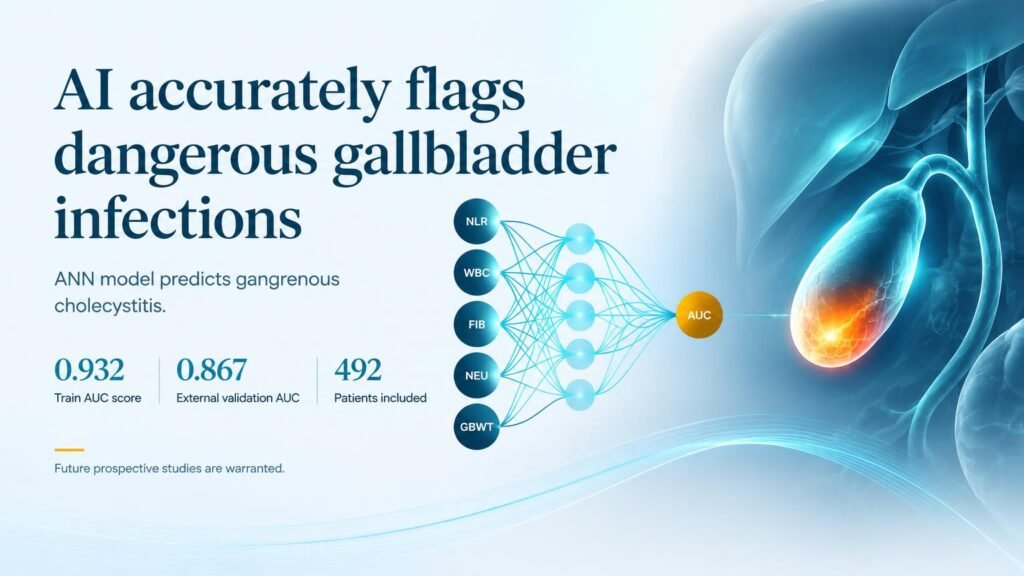
Researchers built seven machine learning models using 39 routine serological and imaging tests from a primary cohort of 492 patients. The artificial neural network (ANN) outperformed logistic regression, decision trees, random forests, XGBoost, LightGBM, and support vector machines across every testing tier.
The network demonstrated exceptional stability across three validation phases:
- Training performance reached an AUC of 0.932 (95% CI 0.900–0.961).
- Internal validation held strong with an AUC of 0.921 (95% CI 0.862–0.966).
- External validation at an independent site achieved an AUC of 0.867 (95% CI 0.790–0.929).
Feature importance analysis revealed five core drivers of prediction risk: neutrophil-to-lymphocyte ratio (NLR), white blood cell count (WBC), fibrinogen (FIB), absolute neutrophil count (NEU), and gallbladder wall thickness (GBWT). SHapley Additive exPlanations (SHAP) were integrated into a web-based calculator, showing surgeons precisely how each biomarker pushes a patient’s risk higher.
This approach echoes recent efforts, such as an explainable predictive machine learning model of gangrenous cholecystitis, which also highlighted feature interpretability as a prerequisite for clinical adoption. Without transparent visual scoring, emergency surgical teams routinely ignore complex algorithms.
From risk scoring to clinical reality
High predictive accuracy does not automatically translate to better survival rates. The model flags high-risk patients efficiently, but retrospective data cannot prove that deploying this software reduces surgical complications or shortens hospital stays.
Surgical departments should view this web tool as a triage assistant rather than a decision-maker. Prospective trials must now verify whether automated risk alerts actually change surgical timing and lower patient harm in high-volume emergency rooms.
Read the full paper in Frontiers in Medicine.