Title: Local AI reads medical notes securely
A new hybrid pipeline proves that small, local AI models can extract hidden clinical data from health records without risking patient privacy or breaking the bank.
How do you extract life-saving data from messy, multilingual clinical notes when sending them to the cloud violates privacy laws? For years, hospitals faced a bad choice. They could pay high fees to commercial cloud APIs, or they could let valuable clinical narratives sit unused. This dilemma has stalled the adoption of advanced analytics in daily clinical workflows.
A new study from Catalonia challenges the assumption that we need massive, cloud-hosted models to parse complex medical records. By running a tiny model locally, healthcare systems can bypass privacy bottlenecks.
This shifts the focus from “bigger is better” to “small, local, and specialized.” It suggests that the future of medical AI is not in the cloud, but on local hospital servers.
The privacy bottleneck
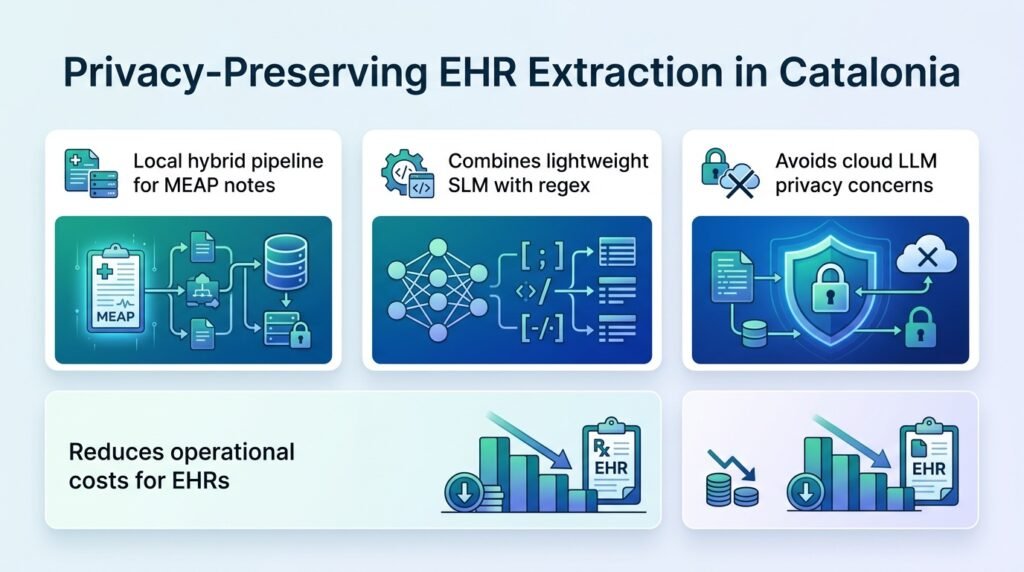
Researchers built a hybrid pipeline using Phi4-mini, a 3.8-billion parameter open-weight model, combined with regular expressions. They deployed it entirely within an institutional firewall using Ollama. This setup completely avoids external API costs and data leaks. The team tested the system on 15,498 primary care narratives from a matched cohort of 2,962 patients to track six uncoded urinary tract infection (UTI) symptoms.
While early breakthroughs like Med-BERT showed the power of structured EHR embeddings, clinical narratives remained difficult to parse without massive resources. Later research confirmed that a large language model for electronic health records could understand free text, but deployment costs remained high. This new Catalan study proves that compact, local models can bridge this gap.
Small models, big accuracy
The pipeline successfully extracted 4,663 clinical feature occurrences, revealing clear clinical patterns. The data showed a stark difference between patients who progressed to severe infections and those who did not. The system proved highly accurate when compared to human experts and synthetic stress tests.
- Patients progressing to acute pyelonephritis had a much higher symptom burden than controls (71.3% vs. 55.8%).
- Fever (33.0% vs. 9.0%) and lumbar pain (29.0% vs. 9.8%) were the strongest indicators of disease progression.
- Real-world clinician validation showed 93.8% accuracy and 96.6% specificity.
- Adversarial stress-testing with synthetic noise maintained 87.2% accuracy and 99.5% specificity.
The trade-off is real
The strategy is highly effective, but it has a clear limitation. The pipeline’s sensitivity dropped to 73.9% during synthetic stress tests. This means the system missed more complex, narratively winding descriptions of symptoms. It is highly precise when it finds a symptom, but it is not exhaustive.
For researchers, this trade-off is acceptable. High specificity means very few false positives, making the data highly reliable for large-scale observational studies. However, clinicians should not rely on this setup for real-time diagnostic alerts where missing a single symptom could harm a patient. Local AI is ready for research, but clinical deployment still requires caution.
Read the full study in medRxiv.