We are seeing a massive shift from theoretical AI performance to hard, real-world validation. The tools that succeed are not necessarily the most complex, but those that respect clinical workflows and actual human constraints.
🔹 Simple AI beats complex models in lung cancer — A massive lung cancer study reveals that simple clinical data paired with explainable AI outperforms complex multimodal models in real-world validation.
When I was building Yesil Health, I realized that feeding more variables into a model usually just adds noise. For builders, this is a clear sign to prioritize clean, basic clinical data over expensive, complex pipelines.
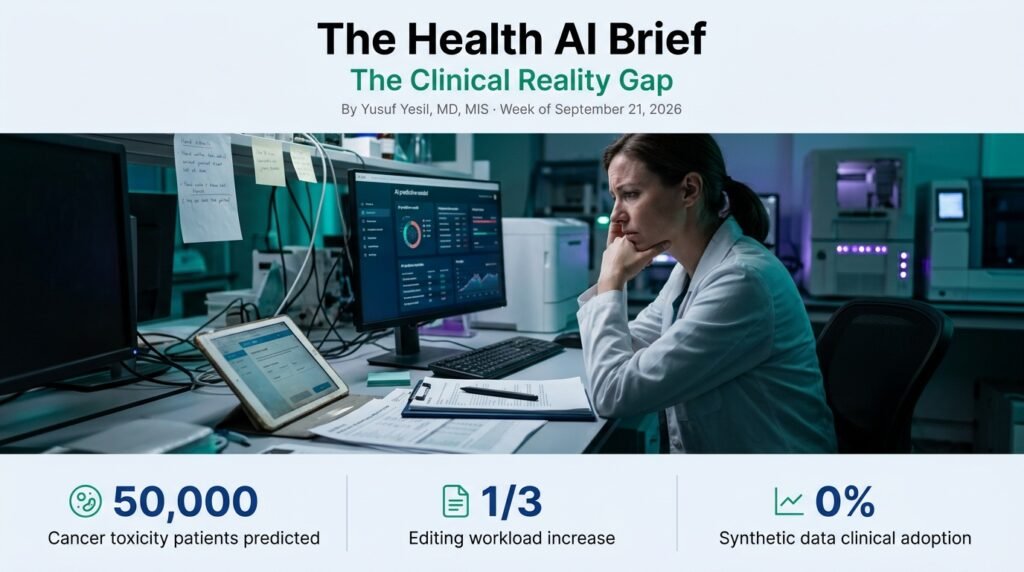
🔹 AI discharge tools make doctors write slower — A new study reveals that while clinicians believe AI saves them time on discharge summaries, the technology actually increases their editing workload by nearly a third.
If you are building in this space, remember that generating text is easy, but verifying it is exhausting. We need tools that integrate seamlessly rather than forcing clinicians to act as full-time editors.
🔹 AI synthetic data research fails to reach clinics — A massive surge in medical AI synthetic data research has produced thousands of academic papers but almost zero real-world clinical tools.
I am highly skeptical of synthetic data as a cure-all for clinical training. It is great for bench testing, but it fails to capture the messy, unpredictable realities of actual patients.
🔹 Healthcare’s Shadow AI Problem Just Got Worse — Hospitals are letting autonomous AI make decisions before IT departments even know the software exists.
Clinicians are desperate to escape administrative burnout, so they will use whatever works. If you are a hospital leader, strict bans will not work; you need realistic, safe governance.
🔹 AI predicts which cancer patients face severe toxicity — A new AI-driven analysis of 50,000 patients reveals that severe cancer treatment side effects are predictable genetic events.
This is a massive win for personalized oncology. If you are seeing patients next week, imagine being able to preemptively adjust chemotherapy dosages based on genetic risk.